

Key Question for Canadians
How can you determine if a complex insurance strategy is a viable long-term solution or just a theoretical concept before you commit your time and capital?
- The Sunk Cost Risk: Standard proposals often rely on theoretical efficiency, drawing applicants into a psychological trap where they accept sub-optimal ratings or unsuitable strategies simply because of the effort already invested.
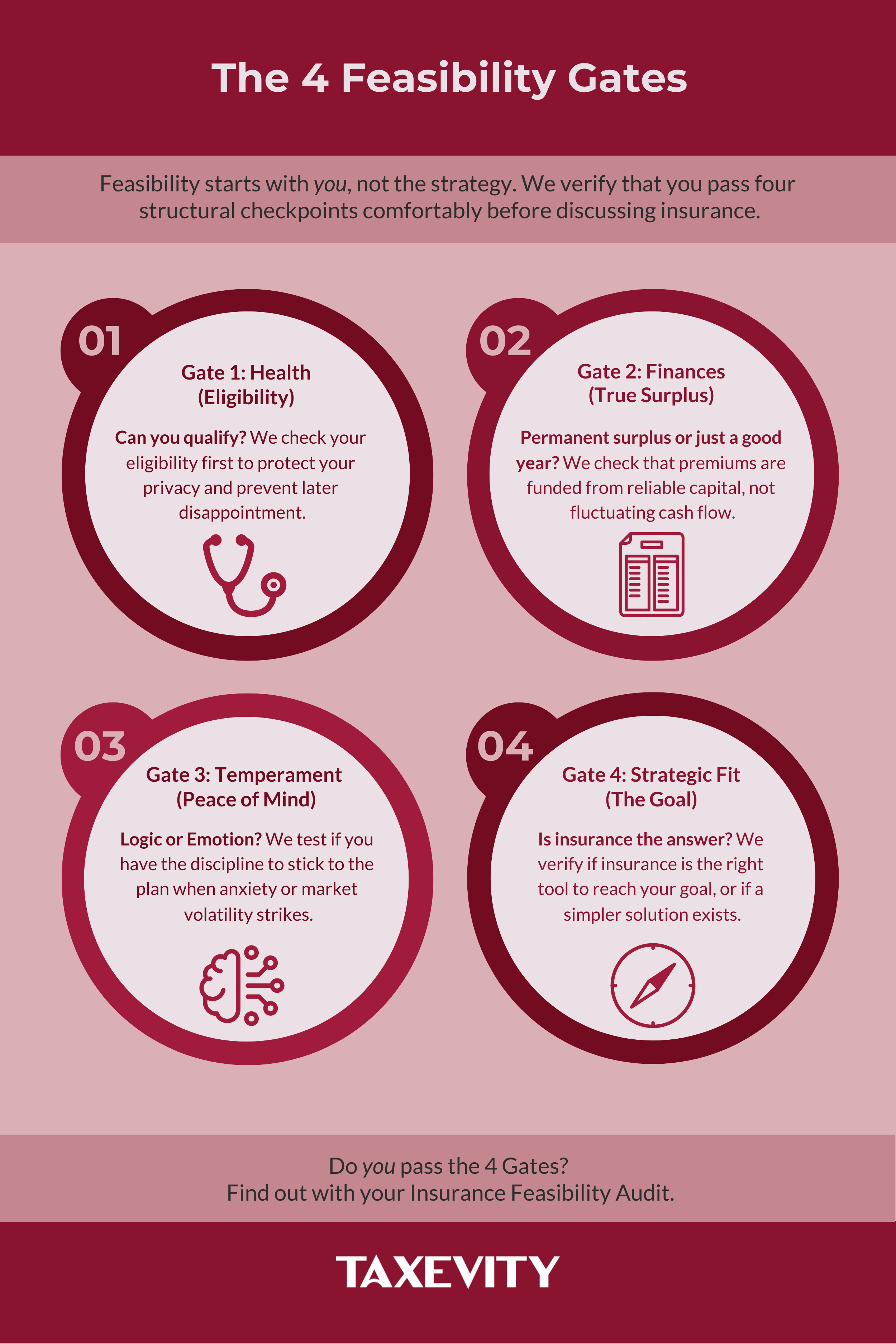
- The Feasibility Check: Before considering an insurance proposal, you must pass four structural gates—confirming your health eligibility, verifying your True Surplus capital, assessing your emotional temperament, and ensuring strategic fit.
- The Benchmarking Outcome: This process creates an independent Reference Model that stress-tests the strategy against your reality, ensuring the insurance is not just a tax tactic, but a solid foundation for your specific Protection or Growth goals.
In our previous post, What is an Insurance Feasibility Audit? (And Why Your Proposal Needs One), we examined why standard insurance proposals—which often rely on simplified concept presentations to sell the big picture while holding back the complex details—are static models that showcase a product’s potential but ignore its breaking points.
This raises a critical question for the high-net-worth Canadians: If other advisors offer the same product from the same insurer at the same price, how do you determine if a specific strategy is viable for you?
At Taxevity, we do not start with the strategy or product. We start with the Insurance Feasibility Audit.
Before comparing dividend scales or product performance, we verify that you pass four distinct Feasibility Gates. If you cannot clear these structural hurdles—Health, Surplus, Temperament, and Strategic Fit—we recommend declining the concept. In practice, this means we advise against proceeding with most of the proposals brought to us for review.
Gate 1: Health (Eligibility)
The Question: Can you qualify for the insurance at reasonable rates?
Many proposals assume Standard or Preferred health ratings, which make the numbers look attractive. Until you have a formal offer from an insurer, those figures are purely theoretical.
The issue isn’t just a higher premium:
- Invasion of privacy: Needless investigation into your personal (and, possibly, corporate) details, if an application was likely to be rejected at the outset
- Medical: Your past, current and projected health are examined. Your doctor is contacted for your records. Fluids and vitals are usually collected too.
- Financial: Your past, current and projected finances are investigated.
- Sunk cost fallacy: After going through the process, you are more likely to proceed even with a substandard rating that affects results significantly because of all the effort you have already invested.

Gate 2: Finances (True Surplus)
The Question: Do you have “True Surplus”?
Life insurance is a long-term (often lifelong) commitment. It requires capital that you will never need for your lifestyle or business operations.
One of the most common errors we see is confusing a good year with permanent surplus.
- The Scenario: A business owner has two great years and commits $100,000/year to a corporate policy.
- The Failure Mode: The business needs cash for payroll, but it is locked into an insurance premium. Cancelling coverage triggers penalties and taxes.
- The Audit: We look for True Surplus—consistent, after-tax, unborrowed capital. We check that the strategy for your financial future does not jeopardize your financial future.
Gate 3: Temperament (Peace of Mind)
The Question: Does your psychology match the strategy’s volatility?
This is the gate most often ignored. Strategies are often sold on mathematical logic, but they fail on human emotion. Often, emotion overrides math—clients are driven by the desire to cut tax bills or the ego boost of finding a “secret” strategy that others overlook.
Consider your peace of mind. An Immediate Financing Arrangement (IFA) involves a floating-rate demand loan. If the Prime Rate jumps to 8%, the math might still hold over a 30-year horizon. Will you hold?
- The Failure Mode: Investors prone to anxiety during market volatility often panic when interest rates rise. They unwind the strategy at the worst possible time, crystallizing a loss. Conversely, herd mentality might lead an investor to getting a popular strategy without understanding the risks.
- The Audit: We assess your history with debt and market fluctuations. If the strategy makes you anxious, it fails the gate.
Gate 4: Strategic Fit (The Goal)
The Question: Does the strategy help you achieve one of your goals?
We often see complex, permanent tax strategies applied to problems that insurance cannot actually solve.
- The Scenario: A client was proposed a Corporate Asset Transfer and incorrectly told they could access tax-free Capital Dividends while they are alive.
- The Legislative Risk: Tax laws are not static. We have seen legislative changes. If you are buying a strategy based on a 50% capital gains inclusion rate, you are betting on decades of political stability.
- Strategy Mismatch: The client purchases permanent life insurance to cover a tax bill that disappears when they sell the business in five years. The tax problem vanishes, but they still have to fund a policy that no longer serves a clear purpose.
- The Audit: We verify that the insurance leads to a viable solution.
Verification Before Implementation (The Benchmarking)
Navigating these feasibility gates is not about finding reasons to say “no” to a viable strategy. It is about ensuring that when we say “yes”, the foundation is solid.
Our Insurance Feasibility Audit is more than a critique; it’s a Benchmarking process. To review the insurance proposal you were given, we create an independent Reference Model using our own conservative standards (e.g., stress-testing interest rates and dividend variances). We then compare the two models side-by-side.
This process turns an intangible feeling about risk into a tangible gap analysis. You will see exactly where your sales proposal deviates from a stress-tested reality.
Next in the Series: The DIY Feasibility Audit: How to Use AI to Judge Your Insurance Proposal
The Feasibility Framework
Master the Methodology
You are reading one part of our 5-stage stress-test for insurance strategies. To fully audit your proposal, review the complete framework:
- Phase 1: The Problem – The Static Trap: Why Proposals Fail
- Understand the hidden risks of static PDFs in a dynamic world.
- Phase 2: The Filter – The 4 Feasibility Gates (This Post)
- The exact criteria we use to approve or reject a strategy.
- Phase 3: The Tool – The DIY Audit with AI
- How to use Artificial Intelligence to verify your advisor’s math.
- Phase 4: The Psychology – The ‘Sleep-at-Night’ Test
- Why mathematical success is irrelevant if you panic.
- Phase 5: Validation – Where to Get a Second Opinion
- Specific scripts to challenge your current advisor.
Ready to move from theory to verification? Book Your Insurance Feasibility Audit

At Taxevity Insurance, we’re passionate about bringing clarity to complex financial decisions. Let us empower you with personalized strategies to achieve your goals. We focus on life and health insurance solutions to protect your business, your family, and your legacy.


