(Part of the IFA Master Curriculum)
Key Question for Wealth Advisors
How can you help clients unlock their trapped corporate wealth, bringing those assets into the holistic financial plan you manage and strengthening your role on their advisory team?
- The Mechanism: The IFA-enhanced CDA strategy uses a leveraged life insurance policy to generate a liquid pool of assets that you can then structure into a diversified, risk-managed portfolio for the client. The eventual death benefit from the insurance policy creates a significant CDA balance that can be used to extract corporate dollars tax-free.
- Your Indispensable Role: Your expertise is central to the strategy’s success. You are responsible for designing an investment portfolio for the leveraged proceeds that supports interest deductibility, assessing the client’s suitability for leverage, and managing the strategy’s risks within the context of their total balance sheet.
- The Practice Benefit: Guiding clients through this process is a key differentiator, allowing you to move beyond portfolio management to comprehensive wealth architecture and solidify your value as a core member of their collaborative team of professionals.
As a wealth advisor, your expertise is centred on constructing and managing optimal portfolios to meet your clients’ long-term financial goals. You diligently focus on asset allocation, risk management, and investment selection. However, for your high-net-worth clients who are business owners or incorporated professionals, a significant portion of their wealth is often “trapped” within their corporations, inaccessible without triggering substantial tax liabilities. This creates a barrier to holistic wealth management, as a large and vital component of the client’s net worth remains outside their personal financial plan.
A sophisticated corporate finance strategy offers a powerful solution. The Capital Dividend Account (CDA) is an important tax mechanism that can be made more powerful with an Immediate Financing Arrangement (IFA), creating what is known as an IFA-enhanced CDA. For details on the core IFA structure, see our foundational guide. This combined strategy is designed to unlock trapped value, creating significant opportunities for tax-efficient wealth transfer and enhanced estate liquidity. Understanding it is essential for wealth advisors who want to provide comprehensive, high-value service to their entrepreneurial clients.
This guide provides a detailed analysis of the IFA-enhanced CDA, tailored specifically for the wealth advisor’s perspective. It will equip you to understand its mechanics, identify suitable clients, and—most importantly—recognize your critical role in its successful implementation.
Page Contents
Section 1: The Core Challenge: Trapped Corporate Wealth
Successful entrepreneurs often accumulate substantial retained earnings within their corporations. This wealth, while a testament to their success, presents a distinct financial planning challenge. It is:
- Costly to Access: Drawing corporate funds for personal use requires paying a salary or dividend, both subject to high marginal tax rates that can erode value by nearly 50%.
- Constrained by Corporate Tax Rules: Corporate passive investment rules can result in high tax rates on investment income, creating a significant drag on growth compared to tax-sheltered vehicles.
This “trapped capital” represents a major hurdle in comprehensive estate and retirement planning, limiting a client’s ability to diversify their personal holdings, fund their lifestyle, or execute their philanthropic goals efficiently.
Section 2: The Solution: Mechanics of the IFA-Enhanced CDA
The IFA-enhanced CDA strategy integrates corporate-owned life insurance with a leveraged investment loan to create significant tax-free distribution capacity upon the death of the insured. It systematically converts a future tax liability into a current investment opportunity and a future tax-free legacy.
Here is an overview of the mechanics:
- Corporate-Owned Life Insurance: The corporation purchases a permanent life insurance policy (typically whole life) on the shareholder. The policy builds a high early cash surrender value (CSV) and becomes a stable, reliable corporate asset.
- Immediate Financing Arrangement (IFA): The corporation collaterally assigns the policy to a third-party lender to secure a loan, often for up to 100% of the premium paid or CSV. This is the IFA.
- Investment of Loan Proceeds: The loan proceeds are returned to the corporation, restoring liquidity. This is where your role as the wealth advisor becomes central. The funds must be invested in a portfolio designed to produce income (e.g., interest, dividends) to satisfy the conditions for deducting the loan interest. For more details, see our Wealth Advisor Companion on Interest Deductibility.
- Tax-Free Payout and CDA Credit: Upon the death of the insured, the tax-free life insurance benefit is paid to the corporation. The corporation uses these proceeds to repay the outstanding IFA loan balance.
- Creation of Surplus CDA Capacity: The corporation’s Capital Dividend Account (CDA)—a notional account that tracks tax-free surpluses—is credited with the full death benefit received, less the policy’s Adjusted Cost Basis (ACB). Because the CDA credit is calculated on the gross death benefit before loan repayment, it generates a credit far larger than the net cash retained by the corporation.
This difference creates Surplus CDA Capacity.
To illustrate, consider this example:
- Life Insurance Death Benefit: $4,000,000
- Outstanding IFA Loan Balance: $2,000,000
- Policy’s Adjusted Cost Basis (ACB): $300,000
Financial & Tax Consequences:
- Net Cash Inflow: The corporation receives $4,000,000, repays the $2,000,000 loan, and is left with $2,000,000 in net cash.
- CDA Credit Created: The CDA is credited with $4,000,000 (Death Benefit) minus $300,000 (ACB), for a total credit of $3,700,000.
The corporation now has $2,000,000 in cash and a $3,700,000 tax-free distribution capacity. After distributing the $2M from the death benefit tax-free, it is left with a Surplus CDA Capacity of $1,700,000. This surplus can now be used for the corporation’s other “trapped” assets, allowing them to be paid out to the estate as a completely tax-free capital dividend.
Section 3: The Wealth Advisor’s Crucial Role
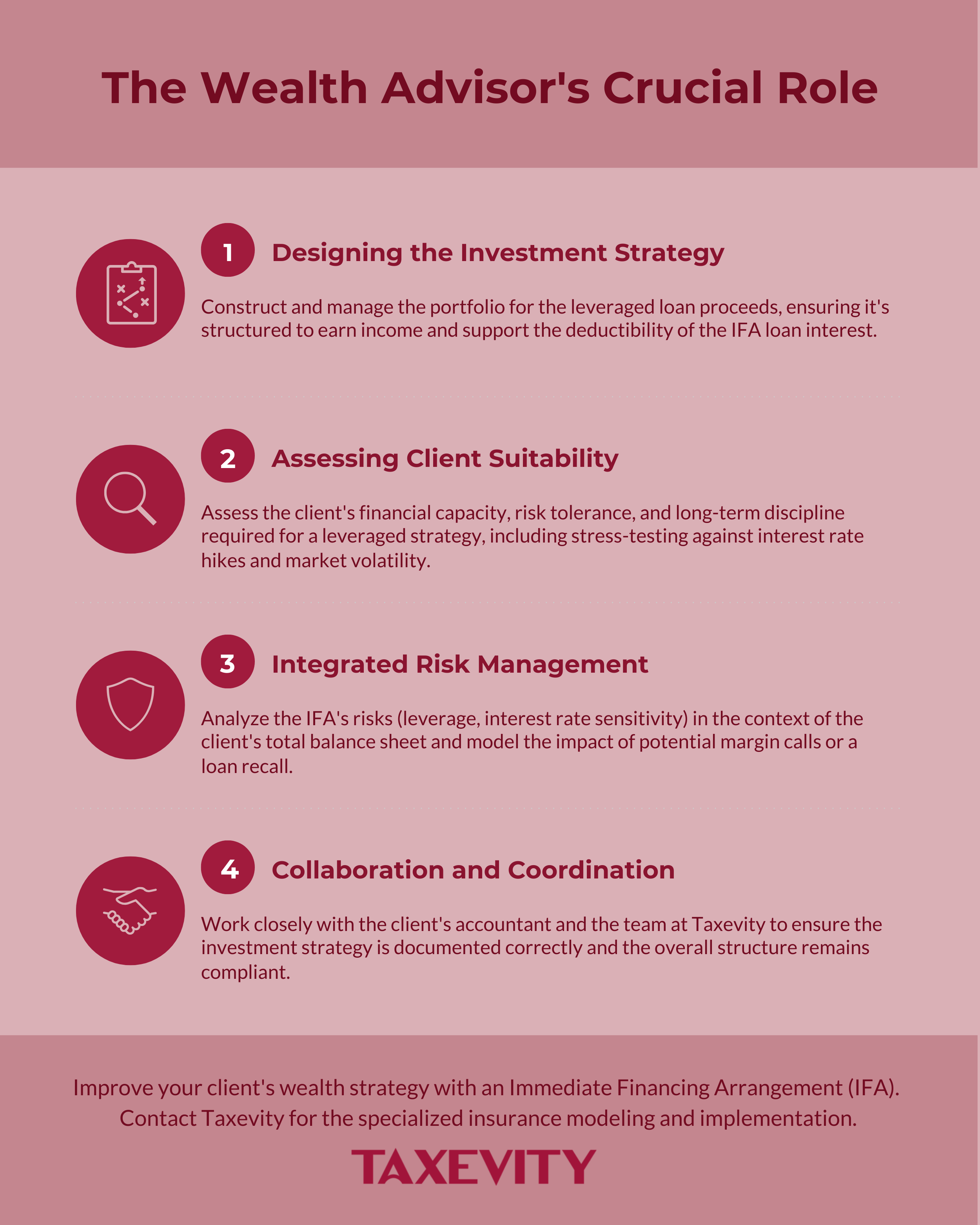
The process starts with the life insurance foundation and IFA modeling from Taxevity. It also requires an accountant for tax compliance. However, your role as the wealth advisor is indispensable for the strategy’s viability and long-term success.
Your key responsibilities include:
- Designing the Investment Strategy: You are responsible for constructing and managing the portfolio for the leveraged loan proceeds. This portfolio must not only align with the client’s Investment Policy Statement (IPS) and risk tolerance but also be structured with the explicit purpose of earning income from property to support the deductibility of the IFA loan interest.
- Assessing Client Suitability: You are uniquely positioned to assess whether a client has the financial capacity, risk tolerance, and long-term discipline for a leveraged strategy. This involves stress-testing their consolidated financial position against interest rate hikes and market volatility.
- Integrated Risk Management: The risks of the IFA (e.g., leverage, interest rate sensitivity, lender risk) must be analyzed in the context of your client’s total balance sheet and existing investment portfolio. You can model the impact of a margin call or a loan recall on the client’s overall financial health.
- Collaboration and Coordination: You must work in close collaboration with the client’s accountant and the team at Taxevity. This ensures the investment strategy for the borrowed funds is documented correctly and that the overall structure remains compliant and aligned with its intended purpose.
Section 4: Benefits for Your Clients and Your Practice
When implemented correctly, the IFA-enhanced CDA strategy offers transformative benefits that directly support the goals of a comprehensive wealth plan.
- Unlocks Trapped Capital for Diversification: It effectively converts illiquid, tax-inefficient corporate capital into a liquid pool of assets that can be managed within a diversified, risk-managed portfolio under your guidance.
- Enhances Estate Liquidity and Preservation: It provides the precise liquidity needed to fund the shareholder’s final tax bill on deemed disposition at death, preventing the forced sale of core business assets or investment holdings at an inopportune time.
- Facilitates Business Succession: The strategy can fund a corporate share redemption from a deceased shareholder’s estate, with the CDA credit significantly reducing the tax impact of the transaction for the estate.
- Deepens Client Relationships: By proactively identifying this opportunity and guiding clients through a sophisticated, high-value strategy, you solidify your position as their lead advisor, moving beyond portfolio management to comprehensive wealth architecture.
Section 5: Conclusion: A Tool for Comprehensive Wealth Advice
The IFA-enhanced CDA is not merely an insurance or tax strategy; it is a powerful corporate finance tool that sits at the intersection of investment management, tax planning, and estate preservation. For the right high-net-worth business owner or incorporated professional, it provides an unparalleled solution to the persistent problem of trapped corporate wealth.
Understanding the mechanics, risks, and benefits of an IFA is a key differentiator for a comprehensive wealth advisor. By embracing your role within the collaborative team of professionals, you can help your clients unlock the full potential of their life’s work, ensuring their wealth is preserved and transferred with maximum efficiency.
The IFA-enhanced CDA is a sophisticated strategy where the right structure is essential. If you believe this approach could benefit your clients, the next step is a detailed, personalized analysis. Contact us at Taxevity to schedule a consultation. We can work with you to model various scenarios using our proprietary tools, helping you and your client make a fully informed decision.

At Taxevity Insurance, we’re passionate about bringing clarity to complex financial decisions. Let us empower you with personalized strategies to achieve your goals. We focus on life and health insurance solutions to protect your business, your family, and your legacy.