

Key Question for Canadians
Why is a mathematically-perfect insurance strategy dangerous if it fails to account for your emotional tolerance to volatility?
- The Temperament Gap: While spreadsheets can calculate an Internal Rate of Return (IRR) to ten decimal places, they cannot model human temperament, which remains the single biggest cause of strategy failure.
- The Panic Tax: If market volatility forces candidates to unwind a leveraged strategy early, the disposition triggers the hidden tax of surrender charges and immediate tax on phantom income, effectively crystallizing a loss.
- The Sleep-at-Night Test: True optimization is not about theoretical efficiency; it is about finding a strategy you can actually stick with for the long term, making your peace of mind the ultimate metric of success.
In our previous post, The DIY Feasibility Audit: How to Use AI to Judge Your Insurance Proposal, we showed you how to verify the figures. In the world of high-net-worth planning, numbers are the easy part.
It is simple to prepare and compare spreadsheets. We can calculate an Internal Rate of Return (IRR) to ten decimal places, project the After-Tax Estate Value out to age 100, and optimize for tax efficiency down to the last cent.
However, there is a variable that no spreadsheet can model, and it is the single biggest cause of strategy failure.
Human temperament.
The importance of this silent checkpoint within the Four Feasibility Gates is most likely to be underestimated.
The Mathematics of Anxiety
Let’s look at a common scenario: The “Optimized” Corporate Strategy.
Mathematically, committing $100,000 of corporate surplus annually to a whole life policy for a decade can make sense. The tax-deferred growth is efficient, the Capital Dividend Account credit is valuable, and the estate benefit is massive.
The modeling assumes your business revenue will grow linearly for the next 20 years.
- Scenario A: Your business grows as projected. You feel brilliant.
- Scenario B: You hit a recession. Revenue drops 30%. That $100,000 premium is no longer just a transfer of surplus; it is a drain on your operating cash.
In Scenario B, the internal long-term math of the insurance hasn’t changed, but your perception of it has. The policy has shifted from an asset to a liability.
When Logic Loses to Emotion
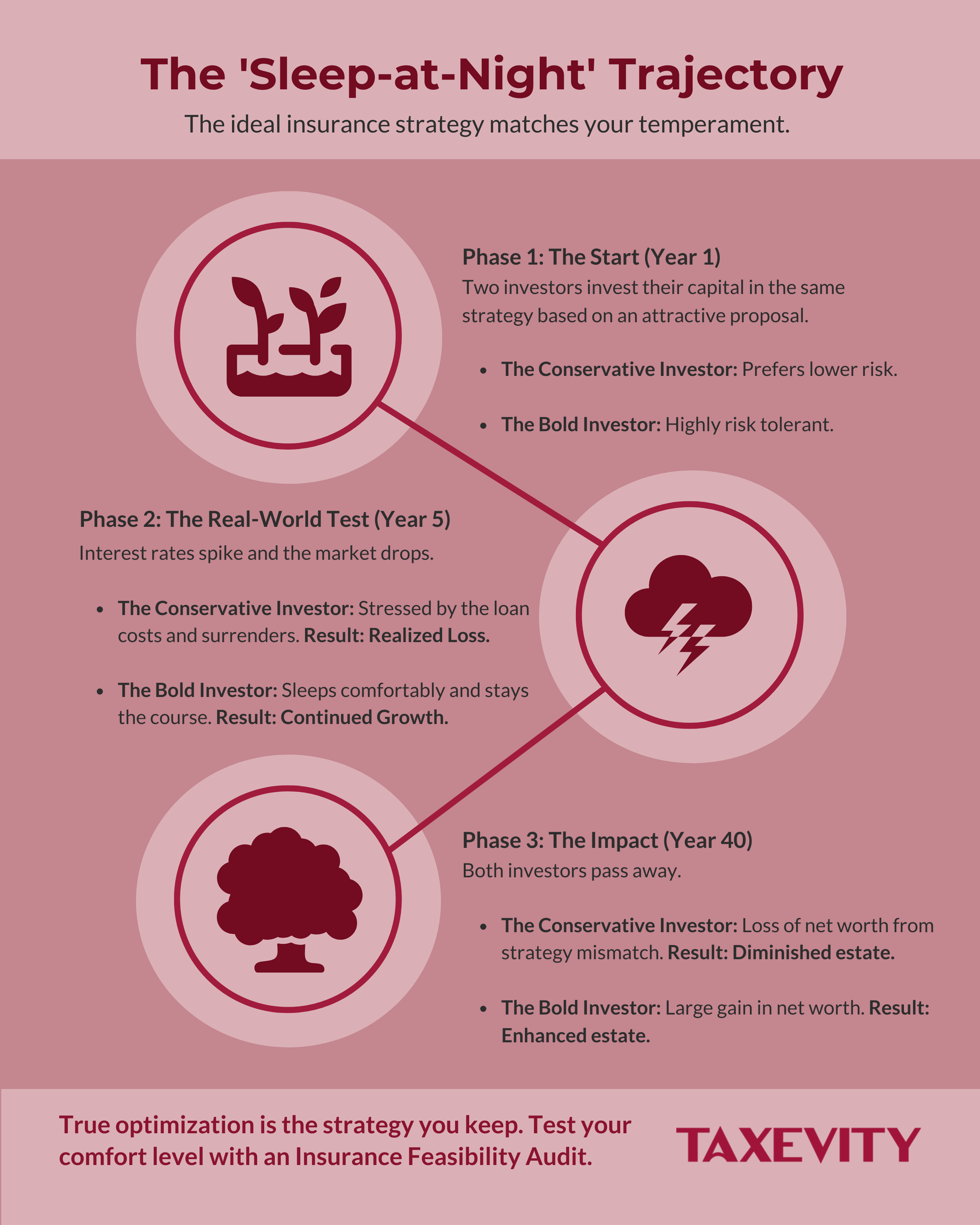
If you are the type of investor who follows trends, or if you lose sleep when your liquidity tightens, a complex, high-commitment strategy may threaten your peace of mind.
Perfectly good strategies get unwound at the worst possible time simply because the psychological pressure of the commitment becomes too much during a downturn.
- The Trap: When you cancel a permanent insurance strategy early (e.g., in Year 5), you often face hefty surrender charges. You crystallize a loss that would have been a gain if only you persisted.
The Hidden Tax: Disposition
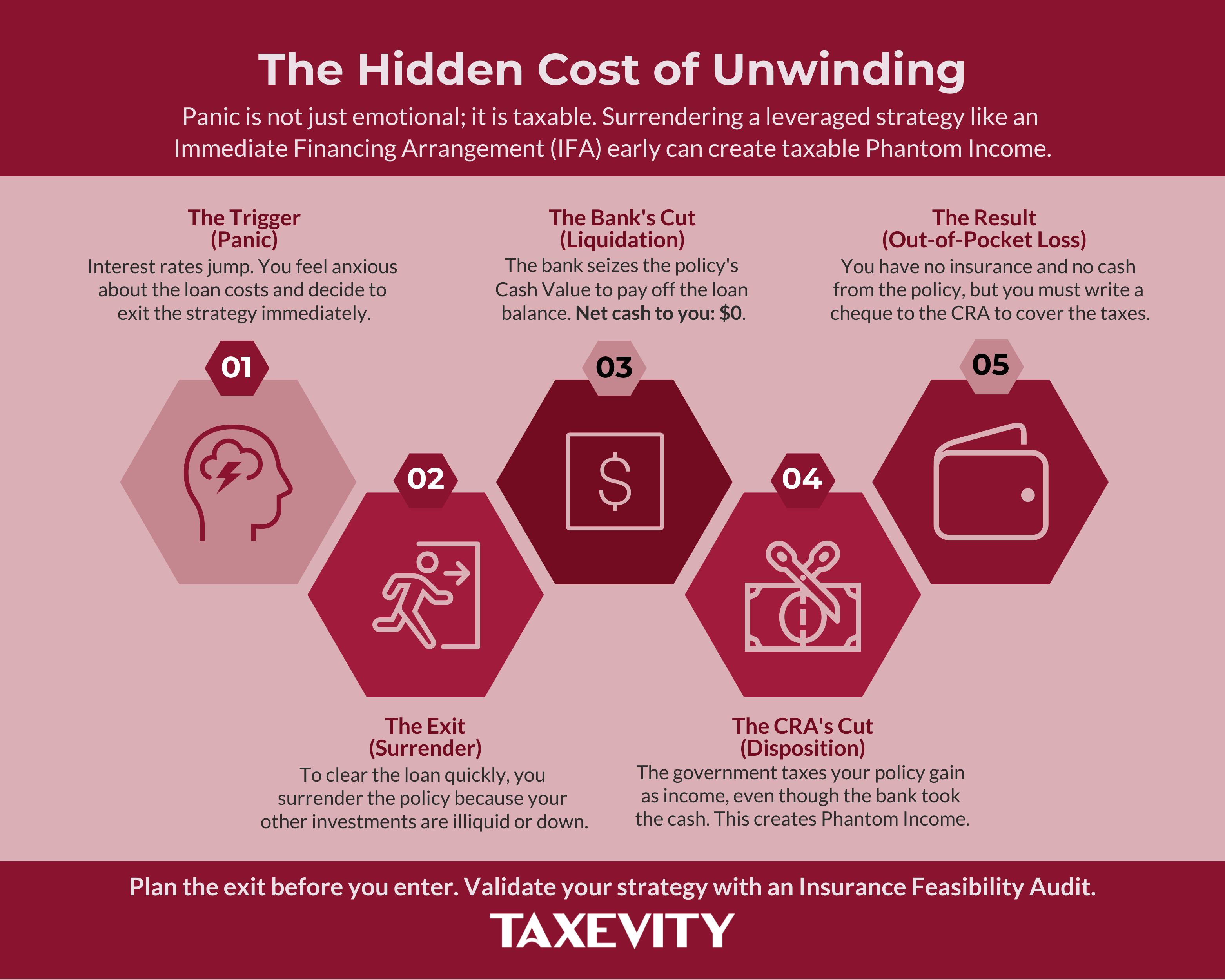
Panic is not just emotional; it is taxable.
If you have a leveraged strategy (like an IFA) and you decide to quit because interest rates have risen, you cannot simply walk away without consequences.
- Loan Repayment: The bank seize the cash value of the policy to repay the loan.
- The Tax Bill: Because the policy is surrendered to pay the debt, this is a disposition of the asset. The CRA treats the proceeds used to pay the bank as proceeds paid to you.
- The Result: You end up with no insurance, no cash (it went to the bank), and the burden of tax on the policy gain (the cash surrender value minus your adjusted cost basis).
Why We Audit for Temperament
During our audit process, we ask questions about your history with commitment and volatility.
- Did you panic-sell stocks in 2008 or 2020?
- Do you view insurance as an expense or an asset?
- Does the idea of a policy contract you cannot easily change make you feel trapped?
A strategy that you stick with for 40 years will always outperform a strategy that you abandon in year 5.
The Ultimate Metric
The ultimate metric is your peace of mind. If a proposal makes you nervous, listen to that instinct—it is often a sign of a structural flaw. Don’t rely on a spreadsheet to predict your sleep. Ensure your strategy is designed for your temperament, not just your tax bracket.
Next in the Series: Your Insurance Proposal: How to Get a Real Second Opinion (With Scripts)
The Feasibility Framework
Master the Methodology
You are reading one part of our 5-stage stress-test for insurance strategies. To fully audit your proposal, review the complete framework:
- Phase 1: The Problem – The Static Trap: Why Proposals Fail
- Understand the hidden risks of static PDFs in a dynamic world.
- Phase 2: The Filter – The 4 Feasibility Gates
- The exact criteria we use to approve or reject a strategy.
- Phase 3: The Tool – The DIY Audit with AI
- How to use Artificial Intelligence to verify your advisor’s math.
- Phase 4: The Psychology – The ‘Sleep-at-Night’ Test (This Post)
- Why mathematical success is irrelevant if you panic.
- Phase 5: Validation – Where to Get a Second Opinion
- Specific scripts to challenge your current advisor.
Ready to move from theory to verification? Book Your Insurance Feasibility Audit

At Taxevity Insurance, we’re passionate about bringing clarity to complex financial decisions. Let us empower you with personalized strategies to achieve your goals. We focus on life and health insurance solutions to protect your business, your family, and your legacy.


