

Key Question for Medical Trainees
How can you structurally protect your future multi-million dollar attending income against unexpected health changes during your training years?
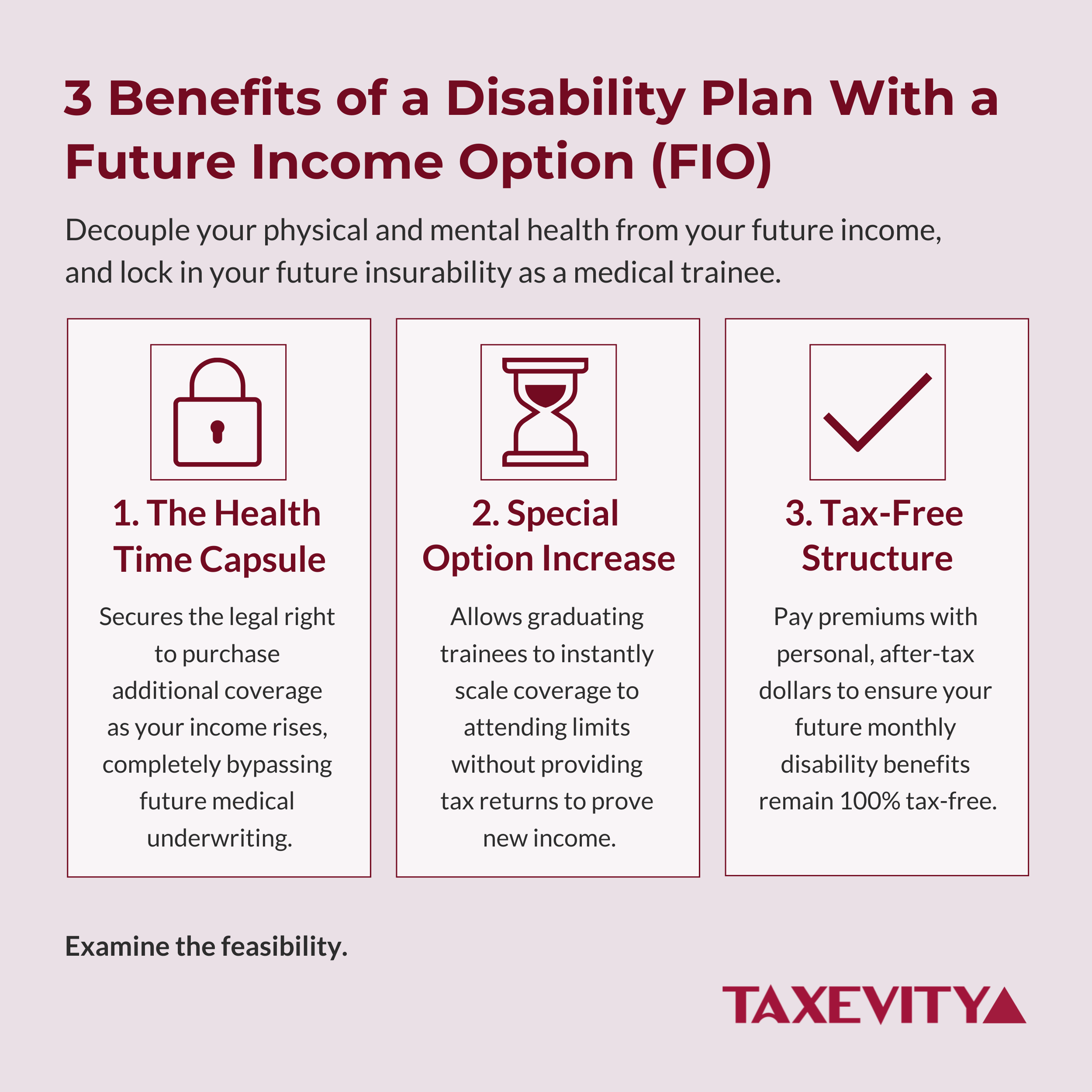
- The Health Vulnerability: As a medical trainee, your income will soon multiply exponentially, but your current coverage limits are mathematically insufficient for an attending lifestyle. If you wait to apply for a new policy later, the stress and physical demands of training could alter your health, potentially making your future wealth uninsurable.
- Decoupling Health and Income: The Future Income Option (FIO) is a contractual rider that decouples your physical health from your future income. It guarantees your legal right to purchase additional coverage as your income rises while completely bypassing medical questions. By securing it early, you successfully lock in your good health for the future.
- The Special Option Increase: To seamlessly bridge the transition to practice, high-quality contracts offer a Special Option Increase. This allows graduating trainees to instantly scale their coverage to first-year attending limits without providing tax returns to prove their new income. Verify the feasibility of integrating this rider into your financial architecture.
If you are progressing through your medical training, you are navigating an extreme financial trajectory. Over the next few years, your income is going to multiply exponentially.
This rapid transition creates a unique structural challenge for your financial architecture. How do you purchase disability insurance today—when your income is low and your debt is high—that will adequately protect the significant attending income you will generate later?
More importantly, how do you guarantee that a sudden change in your health during residency won’t prevent you from insuring that future wealth?
The answer lies in a specific contractual mechanism known as the Future Income Option (FIO). For a medical trainee, this is not a discretionary add-on; it is the non-negotiable engine of your entire risk management strategy.
1. The Mathematical Problem with Trainee Insurance
To understand the value of the FIO, we must first look at the mathematical limitations of applying for insurance as a trainee.
Disability insurers will generally only issue coverage that aligns with your current earnings, or, in the case of medical trainees, specific predefined limits based on your career stage. A resident, for example, is typically capped at securing $4,500 per month in tax-free benefits.
While $4,500 a month provides an excellent foundational safety net during your training years, it is mathematically insufficient for an attending physician. When you transition to practice, your lifestyle, mortgage, and financial obligations will likely require protection ranging from $15,000 to $25,000 per month.
Therefore, the $4,500 policy you buy today is guaranteed to be outgrown. You will inevitably need to buy more coverage.
2. The Threat of Changing Health
If you simply plan to apply for a $10,000 monthly benefit policy when you become an attending, you are exposing yourself to a catastrophic risk: your health.
Medical underwriting is a snapshot in time. If you apply for a new policy at age 30, the insurer will scrutinize your medical records from the grueling years of your residency. What happens if, during those years, you developed chronic back pain? What if you sought counseling for burnout and anxiety? What if you developed high blood pressure or a gastrointestinal issue?
If you have to undergo fresh medical underwriting as an attending, the insurer may attach permanent exclusions to your new policy, charge you significantly higher premiums, or decline to offer you the additional coverage entirely.
Your future wealth would be left exposed.
3. The Architectural Solution: Decoupling Health from Income
The Future Income Option solves this vulnerability.
When you add the FIO rider to your foundational disability policy (such as the RBC Medical Student Offer), you are structurally decoupling your physical health from your future income.
The FIO guarantees your legal right to purchase additional coverage in the future, regardless of what has happened to your health in the interim.
If you secure an FIO today, and two years from now you develop a serious medical condition, the insurer is still legally obligated to sell you additional insurance if your income rises. You have successfully locked your health in a time capsule.
4. The RBC Professional Series: The Special Option Increase
Activating your FIO usually requires proving to the insurer that your income has actually increased (financial underwriting). Typically, this means waiting until you have a full year of attending-level tax returns to present to the insurance company.
However, the transition to practice happens overnight. You cannot afford to wait a year to increase your coverage while you are already living an attending lifestyle and taking on attending-level financial obligations.
To bridge this gap, the RBC Professional Series includes an extra-contractual feature known as the Special Option Increase.
This specialized mechanism opens a distinct window—typically beginning six months prior to the completion of your training and closing six months after. During this window, graduating residents and fellows can exercise their FIO to immediately increase their monthly coverage to the maximum first-year-in-practice limits (often upwards of $11,000 per month for specialists).
Crucially, you do not need to provide tax returns to prove your new income. You simply leverage the Special Option Increase to seamlessly scale your architecture the moment you transition to practice.
5. Structuring for Tax-Free Wealth
As you scale your coverage using your FIO, it is vital to maintain strict structural discipline regarding how those premiums are paid.
Physicians frequently ask their accountants if they should have their Medical Professional Corporation (MPC) pay their disability insurance premiums to secure a corporate tax deduction.
The answer is generally no.
If you pay your disability insurance premiums (including the base policy and the FIO rider) using personal, after-tax dollars, the monthly benefit you receive during a claim is completely tax-free. If you instead deduct the premiums as a business expense, the Canada Revenue Agency (CRA) may tax any disability benefits paid out to you. Paying tax on your disability income severely compromises the structural integrity of your safety net.
Frequently Asked Questions
Is the Future Income Option expensive?
No. The FIO rider typically represents a very small fraction of your overall premium. It is an incredibly cost-effective way to secure millions of dollars of future insurability.
Do I have to exercise all of my FIO at once?
No. Most FIO riders offer an annual option window (often tied to your policy anniversary). You can choose to exercise small blocks of your available FIO year by year as your income gradually rises, or you can exercise larger blocks during major transitions (like using the Special Option Increase).
What happens if I forget to exercise my FIO?
If you forget to elect an increase in one year, you can do it the following year, provided the rider is still active at that time, and you have enough FIO capacity. FIO riders will eventually expire. This is why it’s important to actively monitor your career milestones.
Verify the feasibility.
Protecting your future human capital requires locking in your health today. Before your attending income materializes, ensure your risk management architecture can scale without new medical underwriting.
- Lock in Your Health: Discuss how the FIO rider permanently decouples your physical insurability from your future income.
- Map the Special Option Increase: We will review your specific timeline live on-screen to determine exactly when you can scale your coverage up to attending limits without financial underwriting.
- Structure Your Foundation: If you decide the strategy is feasible, we will help you establish your foundation.
Schedule a private, 25-minute interactive video meeting to explore your options.
This post is part of a five-stage architectural blueprint for protecting your medical career. Review the complete framework:
- Part 1: Deconstructing the RBC Medical Student Offer
- Part 2: The Resident’s Guide to the Mental Health Paradox
- Part 3: The Clinical Fellow’s Financial Blueprint
- Part 4: Medical Association vs. Private Disability Insurance: A Structural Comparison
- Part 5: The Future Income Option (FIO): Protecting Unearned Capital (This Post)

At Taxevity Insurance, we’re passionate about bringing clarity to complex financial decisions. Let us empower you with personalized strategies to achieve your goals. We focus on life and health insurance solutions to protect your business, your family, and your legacy.


