

Key Question for Medical Trainees
How can you protect your future multi-million dollar earning potential against the catastrophic risks of illness or burnout without risking your insurability?
- The Human Capital Asset: As a medical trainee, your greatest asset is your future ability to earn millions of dollars over your career. However, the stress of training brings the risk of burnout, and seeking documented mental health treatment can paradoxically make you uninsurable under standard underwriting guidelines.
- The Two-Step Failsafe Protocol: To safely lock in coverage, first secure a baseline using a simplified issue program. The RBC Medical Student Offer (MSO) provides a guaranteed 10% discount without medical exams. Once this foundational protection is legally in force, you can then safely apply for a fully underwritten policy to potentially secure a 25% discount, knowing your baseline is safe if you do not qualify.
- Guaranteed Future Insurability: By securing a private, non-cancellable contract early, you establish a guaranteed foundation that an insurer cannot alter or cancel. Furthermore, utilizing a Future Income Option (FIO) allows you to purchase additional coverage as your income grows into your attending years, completely bypassing future medical questions. Examine the feasibility of this structured approach for your specific medical discipline.
If you are reading this, you are likely in the thick of medical training. Whether you are a first-year medical student subsisting on coffee and a line of credit, a resident working grueling 80-hour weeks, or a fellow on the cusp of that long-awaited attending leap, your financial reality is entirely unique.
Right now, your balance sheet probably doesn’t look great. In fact, for many trainees, net worth is significantly negative. Yet, the financial industry constantly tells you that you need to purchase Disability Insurance (DI).
If you’ve spent any time researching this online, you’ve probably hit a wall of confusing, conflicting information. You might be reading about 10% discounts versus 25% discounts, simplified underwriting versus full medicals, and why you shouldn’t just rely on your provincial medical association.
We are going to walk through exactly how disability insurance works for Canadian medical trainees, why the mental health paradox matters, and how to navigate the RBC Medical Student Offer (MSO) strategically.
Think of this post as a blueprint for your financial foundation.
1. The Human Capital Equation: What Are We Actually Insuring?
The most common—and entirely logical—question we hear from medical trainees is this: “Why would I pay for disability insurance when my current income is essentially zero?”
It’s a fair question. We usually think of insurance to protect tangible assets like a home or car. As a medical trainee, your most valuable asset isn’t tangible yet. It’s your Human Capital.
Human capital is your ability to wake up every day, apply your highly specialized training, and generate income for decades. Let’s do some quick, conservative math. If you become a specialist earning an average of $350,000 a year over a 30-year career, your human capital is worth over $10,000,000.
You aren’t insuring your current resident stipend; you are hedging against the catastrophic loss of a multi-million dollar asset.
The Debt Reality
Medical training is an exercise in immense leverage. You are borrowing heavily against your future self. Even if you are fortunate enough to have family support or scholarships, the sheer cost of medical education, combined with years of delayed income, creates a structural vulnerability.
If a physical injury, a chronic illness, or a severe mental health condition prevents you from completing your training or practicing your chosen specialty, those future millions of dollars vanish. Yet, the debt remains. Disability insurance simply transfers this massive risk from your shoulders to the balance sheet of an insurance company.
2. The Association Plan Illusion
Many trainees default to the disability insurance offered by their provincial medical association (such as the OMA, Doctors of BC, etc.). The natural assumption is that the association plan is the safest, most loyal, and most cost-effective choice designed specifically for your benefit.
While these plans offer an accessible entry point, relying on them as your primary foundation is a structural flaw.
Association plans are group contracts. The association, not you, owns the master policy. This means the definitions of disability can be altered, the coverage is often not globally portable if you move, and most importantly, the premiums are typically age-banded—meaning they get progressively more expensive as you get older. Furthermore, the insurer holds the right to increase rates for the entire group block if claims experience is poor.
To build a permanent foundation, you require a private, individual contract where you are the sole owner, and the terms and premiums are contractually locked in until age 65.
3. The Mental Health Underwriting Paradox
Before we talk about specific private insurance products or discounts, we need to have a very candid conversation about mental health in the medical profession.
Medical school and residency are notoriously, undeniably stressful. The pressure, the hours, and the emotional weight of patient care as you transition into residency may trigger burnout, anxiety, and depression. Let us be absolutely clear: seeking therapy, counseling, or psychiatric care is a critical, healthy, and necessary response to this pressure. It makes you a better physician.
However, the insurance world views risk through a very cold, financial lens, creating what we call the Mental Health Underwriting Paradox.
If you apply for a fully underwritten disability insurance policy, the insurer will request your complete medical history. If they see a recent, documented history of anxiety, depression, or burnout counseling, they view that as an increased risk. As a result, they may issue a policy with a psychiatric exclusion (meaning they won’t pay a claim related to mental health), or in some cases, they may decline your application altogether.
This is the paradox: the very training required to become a doctor often creates the medical history that prevents you from getting the insurance you need to protect your career.
The Solution: Lock It In Early
This is exactly why getting your disability insurance architecture in place early—ideally in your first or second year of medical school, or as early in residency as possible—is so critical. When you secure a non-cancellable contract while your medical record is relatively clear, you lock in your insurability.
If you subsequently experience burnout during your residency and seek the therapy you deserve, your insurance is already in place. The insurer cannot retroactively change your contract, increase your premiums, or cancel your coverage.
4. Demystifying the Market: MSO vs. SSP
When you research private disability insurance for Canadian medical students, RBC Insurance is invariably the dominant provider.
This is where much of the online confusion stems from. You may see marketing that promises a 25% lifetime discount for medical students with no medical exams. That is fundamentally inaccurate. It represents a blending of two completely different programs that RBC offers.
To protect your insurability, you need to understand the strict difference between these two doors:
Door A: The Medical Student Offer (MSO)
The MSO was designed specifically to remove the friction for busy trainees. It is a Simplified Issue program. This means there are no physical exams, no blood tests, no urine samples, and no attending physician statements required. You answer a few basic health questions, and if you qualify, you are granted a world-class policy with a guaranteed 10% lifetime discount.
Door B: The Student Savings Program (SSP)
The SSP is a Fully Underwritten program. It is designed for applicants who are willing to undergo rigorous scrutiny to get a better rate. You will have to provide a full medical history, potentially do bloodwork, and answer extensive lifestyle questions. If—and only if—you pass this underwriting perfectly, you can secure up to a 25% lifetime discount without coverage exclusions.
Here is a quick visual breakdown of how the two paths compare:
| Feature | Medical Student Offer (MSO) | Student Savings Program (SSP) |
| Underwriting Style | Simplified. No physicals, no fluids. Quick and frictionless. | Full. Evaluation of your medical and lifestyle history. |
| The Discount | 10% guaranteed lifetime reduction. | 25% lifetime reduction, if healthy. |
| Premium Waivers | 12 months free for Med Students; 5 months for Residents and Fellows. | 5 months free for everyone who’s approved |
| The Goal | Establish a guaranteed, safe baseline of protection immediately. | Maximize premium savings, but at the risk of medical scrutiny. |
The Cost of Price Shopping
Selecting disability insurance based solely on the lowest premium is a dangerous strategy. Just as you would not choose a medical school or a residency program simply because it had the cheapest tuition, you should not secure your immense human capital with a discount-first mindset. Contractual certainty and strictly defined language are far more valuable than saving a few dollars a month.
5. The Two-Step Failsafe Sequencing Protocol
Which door should you choose? Human nature dictates that we all want the 25% discount. Why settle for 10%?
Here is where strategic architecture matters. If you walk directly through Door B (the SSP) to chase the 25% discount, and the underwriter finds an issue with your health they might decline your application or issue it with exclusions.
Once you are declined, rated (your premiums are higher compared to someone in standard health), or given exclusions on a full medical application, a record is created. You are now irrevocably barred from going back and trying to use the simplified MSO program. You essentially lock yourself out of the easy path.
This is why we use the Two-Step Failsafe Protocol:
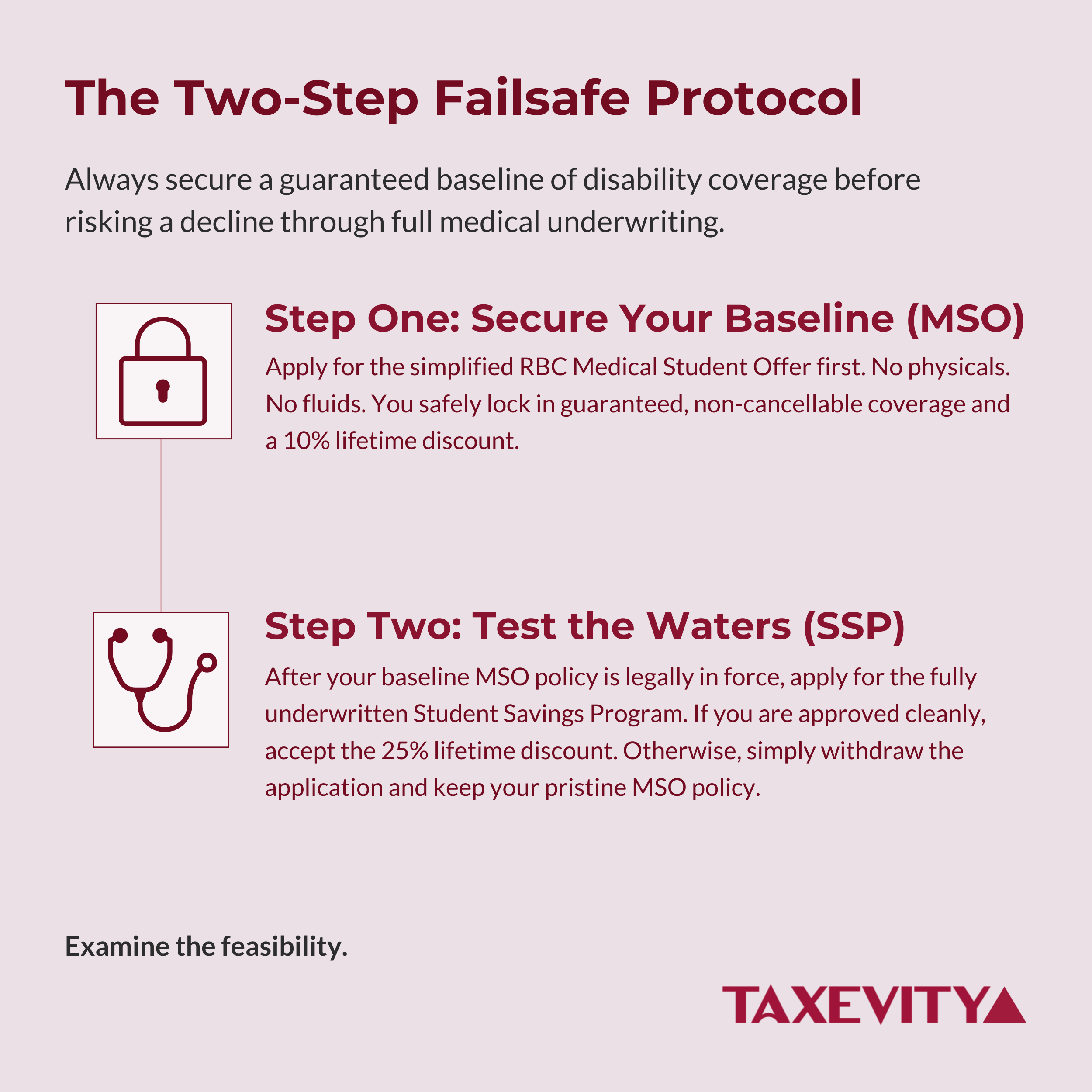
- Step One: Secure the Baseline. We always start by applying for the simplified Medical Student Offer (MSO). Because it requires no medical exams, this is the safest way to instantly lock in guaranteed, non-cancellable coverage and your 10% discount.
- Step Two: Test the Waters. Only after your baseline MSO policy is legally in force do we apply for the fully underwritten Student Savings Program (SSP).
If the SSP is approved with a clean bill of health, fantastic! We simply replace the initial policy with the new one, and you enjoy your 25% discount. However, if the SSP is declined or comes back with unexpected exclusions, you simply withdraw the application. You still have your MSO policy.
6. Bypassing the Financial Roadblocks
If someone applies for a mortgage or a standard loan, you know that financial institutions want to see a history of high income. Traditional disability insurance is no different; normally, an insurer will only cover a percentage of the income you are currently earning.
Naturally, this creates a significant roadblock for a medical student earning zero dollars, or a resident earning a modest stipend while carrying huge debt.
The value of these specific student offers is that they completely bypass traditional financial underwriting. The insurer isn’t looking at your current T4 slips; they are looking at your trajectory. They establish predefined, guaranteed issue limits based entirely on where you are in your medical education journey.
| Your Current Stage | Maximum Monthly Tax-Free Benefit |
| First & Second-Year Medical Student | $2,000 |
| Third-Year Medical Student | $3,000 |
| Fourth-Year Medical Student & Residents | $4,500 |
| Active Clinical Fellow | $8,500 |
If you are within three months of graduating to the next tier (e.g., a 4th-year student about to start residency), guidelines generally allow you to apply for that higher tier’s limit immediately. Also note that if you pay your disability insurance premiums with personal, after-tax dollars, the monthly benefit you receive is completely tax-free.
7. The Engine Under the Hood: Contractual Architecture
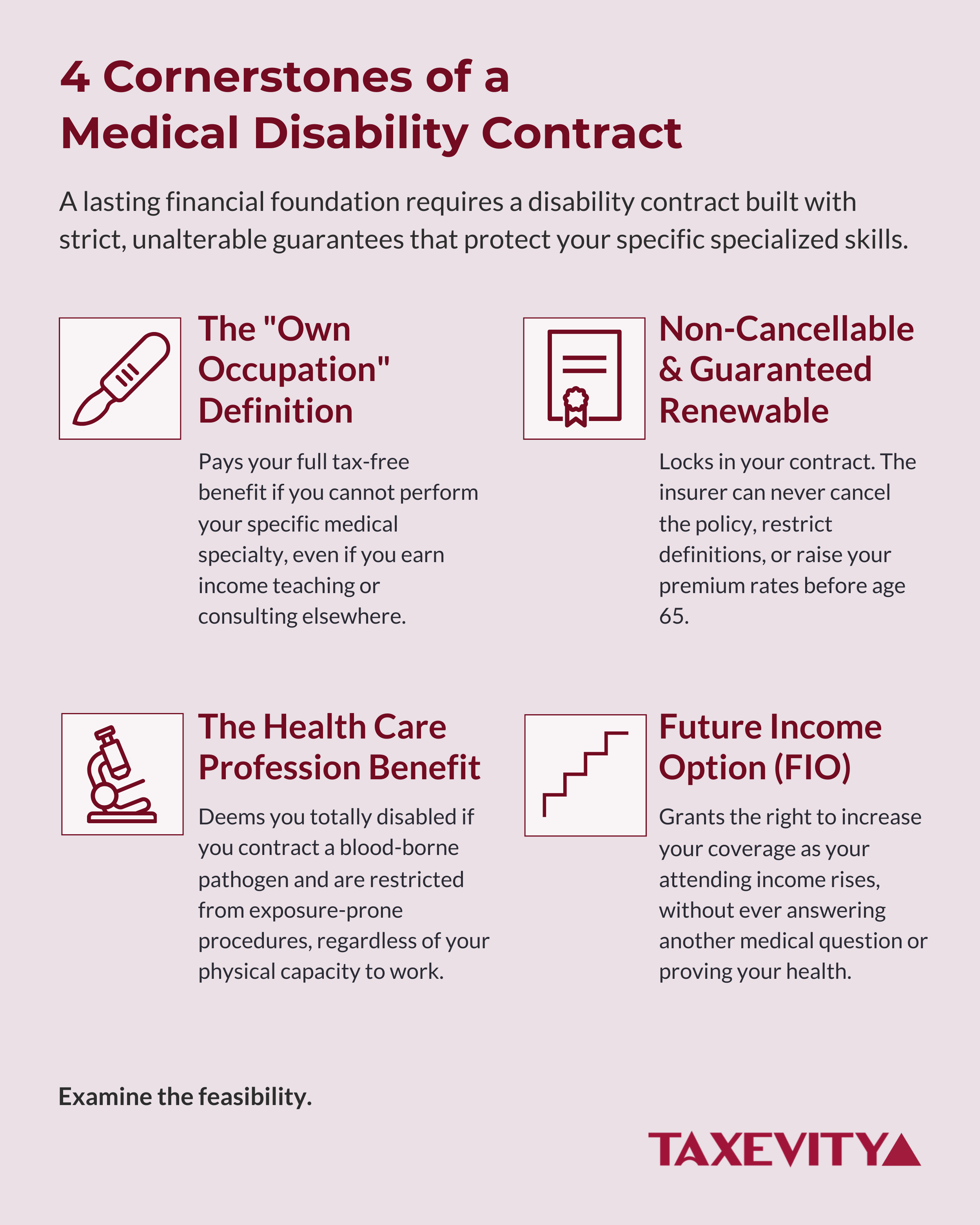
Having insurance is one thing; having the right insurance is another. The RBC Professional Series (which is the chassis that the MSO and SSP are built upon) contains several non-negotiable architectural components. Think of these as the cornerstones of your policy.
The “Own Occupation” Definition
This is arguably the most famous term in medical disability insurance. If you hold a strict “Own Occupation” policy, the insurer will pay your full benefit if you cannot perform the essential duties of your specific medical specialty.
Imagine you are an orthopedic surgeon, and you develop a severe, permanent tremor in your hands. You can no longer operate. Under a true “Own Occ” definition, you are considered totally disabled and will receive your tax-free monthly benefit. Crucially, if you decide to pivot your career—perhaps taking a lucrative job teaching at a medical school or consulting for a medical device company—you still collect your full disability benefit on top of your new income. You are insured for your specific skill, not just your general ability to work.
Non-Cancellable & Guaranteed Renewable
You want total control over your contract. A non-cancellable policy means that once the contract is signed, the insurer can never cancel the policy, alter the definitions to make them stricter, or raise your premium rates before age 65. Even if you make multiple claims, or your health deteriorates dramatically, the contract remains locked in stone.
The Health Care Profession Benefit
This is a rider designed specifically for those in the medical field. If you accidentally contract a blood-borne pathogen (such as HIV or Hepatitis B/C) and your governing medical body restricts you from performing exposure-prone procedures, you are legally deemed totally disabled. The insurer will pay your benefit, entirely independent of your actual physical capacity to work.
8. Future-Proofing: The Magic of the FIO
A resident today, would be wise to secure a policy for $4,500 a month. That’s great for now, but fast forward five years: they are a fully practicing attending physician with have a mortgage, perhaps a family, and a lifestyle that requires $15,000 a month to sustain.
That $4,500 policy is now mathematically insufficient. What if their health changed? What if they developed a back issue, or high blood pressure?
This is where the Future Income Option (FIO) becomes the single most important rider on your policy.
The FIO is the contractual right to purchase additional blocks of coverage in the future, as your income rises, without ever answering another medical question. Essentially, you are locking in your current good health and carrying it with you for the rest of your career. When your income jumps, you exercise your FIO, and the insurer must grant you the extra coverage, regardless of any new medical conditions you may have developed.
The Special Option Increase
When you transition from trainee to attending your insurance needs to keep up. The RBC MSO features a Special Option Increase. This allows graduating residents and fellows to exercise their FIO to immediately increase their coverage to the maximum first-year-in-practice limits (often up to $11,000/month for specialists) without having to wait for their tax returns to prove their new income.
This option is a frictionless bridge from your training years into your high-earning years.
The insurance e-application process is designed to be streamlined, but it still requires honesty and precision. If the answer to a question is yes—specifically regarding the mental health lookback—you must say yes.
Answering ‘yes’ doesn’t mean you are declined. Instead, it typically results in a psychiatric exclusion. This is a targeted amendment: your policy remains fully in force for physical injuries, illnesses, and accidents, but it will not pay a benefit if you are disabled specifically by a psychological condition.
While an exclusion isn’t ideal, securing the physical coverage is far better than having no coverage at all. More importantly, this exclusion isn’t always a life sentence. Insurer guidelines often allow them to reconsider and potentially remove exclusions after enough time has passed, provided you can submit objective evidence that you have remained entirely symptom-free and required no treatment during that time.
Frequently Asked Questions
Do Canadian medical students get a discount on disability insurance?
Yes. Through the simplified Medical Student Offer (MSO), trainees receive a guaranteed 10% lifetime discount. If a trainee applies for the fully underwritten Student Savings Program (SSP) and passes strict medical underwriting, they can secure up to a 25% lifetime discount.
Do I need a medical exam to get disability insurance as a resident?
No. If you apply through the RBC Medical Student Offer (MSO), the process is Simplified Issue. This means there are no physical medical exams, blood tests, or urine collections required.
Is the OMA disability insurance good enough for a medical student?
Provincial association plans (like the OMA) are convenient, but they are group contracts. They do not offer the permanent, non-cancellable, guaranteed-level premiums found in private individual contracts. Private contracts are highly recommended as the foundational layer of your protection.
Get clarity on the feasibility.
Protecting your multi-million dollar human capital requires a properly sequenced strategy. Before you apply, ensure your approach won’t accidentally jeopardize your future insurability.
- Ask Questions: Discuss your unique timeline and concerns without pressure.
- See the Numbers: We will build and review your custom premium projections and discount structures live on-screen.
- Take Action: If you decide the strategy is feasible for you, we will guide you through the sequenced e-application process to safely lock in your foundational coverage.
Schedule a private, interactive video meeting to explore your options and see the math for yourself.
The Series: The Medical Trainee’s Guide to Disability Insurance
This post is part of a five-stage architectural blueprint for protecting your medical career. Review the complete framework:
- Part 1: Deconstructing the RBC Medical Student Offer (This Post)
- Part 2: The Resident’s Guide to the Mental Health Paradox
- Part 3: The Clinical Fellow’s Financial Blueprint
- Part 4: Medical Association vs. Private Disability Insurance: A Structural Comparison
- Part 5: The Future Income Option (FIO): Protecting Unearned Capital

At Taxevity Insurance, we’re passionate about bringing clarity to complex financial decisions. Let us empower you with personalized strategies to achieve your goals. We focus on life and health insurance solutions to protect your business, your family, and your legacy.


