

Key Question for Medical Professionals
How can you guarantee the long-term cost and contractual certainty of your disability insurance when provincial association plans can unilaterally change their terms or raise group rates?
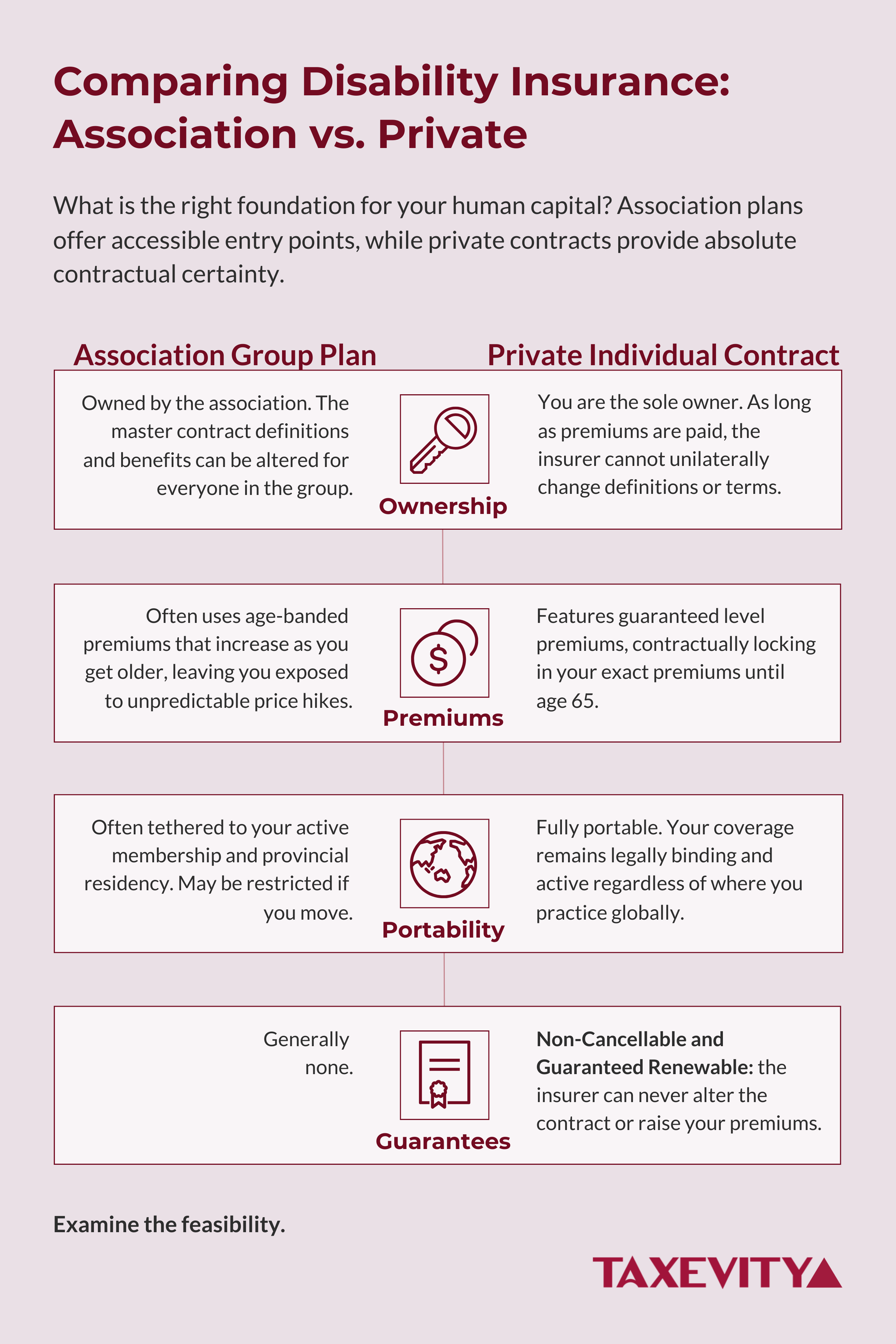
- The Illusion of Control: Provincial medical association plans are group master contracts owned by the association, meaning the definitions, benefits, and premiums can be altered for everyone in the group. Furthermore, their age-banded pricing structure automatically increases your costs as you approach your peak earning years.
- The Private Passport: To establish a permanent foundation, you require a private, individual contract where you are the sole owner. These contracts offer a Guaranteed Level Premium structure, locking in your pricing until age 65, and remaining fully portable regardless of where you practice in the world.
- Non-Cancellable Certainty: By securing a non-cancellable private contract, the insurer is legally barred from altering the language or raising your premiums. While group plans are useful as a temporary supplement during training, your multi-million dollar human capital demands a private, immovable foundation. Verify the feasibility of your current contractual architecture.
When establishing your financial architecture, one of the most consequential decisions you will make involves the type of disability insurance you select.
Physicians are heavily marketed to by their provincial medical associations—such as the Ontario Medical Association (OMA), Doctors of BC, or Doctors Manitoba—offering specialized group insurance programs. These plans are accessible and often present very attractive initial premiums, particularly for students and residents.
There is, however, a profound structural difference between an association group plan and a private individual contract.
This guide provides an objective examination of the two approaches, explaining why relying solely on an association plan can introduce critical vulnerabilities into your financial foundation.
1. The Core Difference: Ownership and Control
The fundamental difference between these two types of insurance lies in who actually owns and controls the contract.
The Association Group Plan
When you enroll in an association plan, you are not buying an individual insurance policy. The provincial association has negotiated a master contract with a large insurance carrier. You are simply joining that group and receiving a certificate of coverage.
You are not the policy owner; you do not control the terms of the contract. If the association renegotiates the master contract with the insurer, the definitions, benefits, and premiums can change for everyone in the group, including you. In extreme cases, if the insurance carrier decides to drop the association (as Sun Life did with the OMA), the underlying structure of your protection could shift.
The Private Individual Contract
When you purchase a private disability insurance policy (such as the RBC Professional Series), you enter into a legally binding contract directly with the insurer.
You are the sole owner of this contract. As long as you pay your premiums on a non-cancellable contract, the insurer cannot unilaterally change the definitions, reduce your benefits, or alter the terms of the agreement. You retain absolute control over your financial architecture.
2. Premium Stability vs. Age-Banded Escalation
The cost of your insurance over a 30-year career is a critical factor, and the two models approach pricing very differently.
Association Plans: Age-Banded Pricing
Association plans typically use step-rate or age-banded pricing. This means your premium starts very low when you are young and healthy, but automatically increases at specific age intervals (e.g., every five years). While this makes the plan highly affordable during residency, the cost can escalate dramatically as you approach your peak earning years in your 40s and 50s.
Furthermore, these rates are not guaranteed. If the overall group of physicians experiences a higher-than-expected number of claims, the insurer can (and frequently does) increase the premium rates for the entire block of members, regardless of your personal health history.
Private Contracts: Guaranteed Level Premiums
A high-quality private contract offers a guaranteed level premium structure. This means the premium you agree to when you sign the contract is locked in and guaranteed never to increase until age 65.
While the initial cost may be slightly higher than the starting rate of an association plan, the long-term cost certainty is invaluable. You are essentially hedging against inflation and locking in your pricing based on your age and health at the time of application.
3. Portability and Geographic Freedom
Medical careers are increasingly dynamic. You may pursue a fellowship in the United States, participate in a Doctors Without Borders mission, or simply decide to relocate your practice to a different province.
The Association Tether
Association group plans are intrinsically tied to your active membership in that specific provincial organization. If you move out of the province and cancel your membership, you may lose your disability coverage entirely. Some plans offer limited portability options, but they are often complex and restrictive.
The Private Passport
A private individual contract is completely decoupled from your professional affiliations or geographic location. Once the policy is in force, you can typically maintain your coverage regardless of where you live or practice in the world, provided you continue paying your premiums. It is a fully portable asset.
4. Contractual Certainty: Non-Cancellable vs. Guaranteed Renewable
The terminology used in insurance contracts dictates the level of security you actually possess.
The Standard for Private Contracts
The gold standard for a physician is a “Non-Cancellable and Guaranteed Renewable” private contract. This specific legal phrasing ensures two crucial protections:
- Guaranteed Renewable: The insurer cannot cancel your policy before age 65, even if your health deteriorates or you file multiple claims.
- Non-Cancellable: The insurer cannot increase your premium rates or alter the contract language.
The Reality of Group Plans
Association group plans are generally only “Guaranteed Renewable” at the group level. While they cannot cancel your individual certificate simply because you get sick, they can cancel the entire master contract or, as discussed, raise the premium rates for the entire group. They lack the “Non-Cancellable” guarantee that provides true cost certainty.
5. The “Own Occupation” Definition
As discussed in our Resident’s Guide, the definition of disability is the engine of your policy.
Both high-quality private contracts and robust association plans typically offer a “Regular Occupation” or “Own Occupation” definition, meaning they pay a benefit if you cannot perform the duties of your specific medical specialty.
However, you must read the fine print of group plans carefully. Some association plans may transition the definition from “Own Occupation” to “Any Occupation” after a certain period (e.g., 24 months of disability). An “Any Occupation” definition means the insurer can stop paying your benefit if they determine you are physically capable of working in any reasonable job, even if it is outside of medicine, and no openings exist.
A true, private “Own Occupation” contract maintains that strict specialty-specific definition all the way to age 65.
The Architect’s Verdict: Layering Your Protection
An association plan is a poor pillar when solely supporting your multi-million dollar human capital.
The structurally sound approach to build a layered defense:
- The Foundation: Establish a private, Non-Cancellable individual contract as early as possible. This secures your core “Own Occupation” protection, locks in your health status, and guarantees your long-term premiums.
- The Supplement: If additional coverage is required (or if budget constraints are extremely tight during training), use the association group plan as a supplementary layer to top up your benefits temporarily.
- The Transition: As your attending income stabilizes, rely on your private contract’s Future Income Option (FIO) to increase your permanent coverage, gradually reducing or eliminating your reliance on the association plan.
Verify the feasibility.
Do not leave the protection of your most valuable asset to a group contract you do not control. Before relying solely on an association plan, objectively compare the structural differences.
- Review Your Ownership: Discuss the specific vulnerabilities of group master contracts versus the control of a private, non-cancellable policy.
- Compare the Pricing: We will map out your custom projections live on-screen, comparing age-banded association rates against a guaranteed level premium structure.
- Layer Your Architecture: If you decide the strategy is feasible, we will help you establish a private foundational shield.
Schedule a private, 25-minute interactive video meeting to explore your options.
The Series: The Medical Trainee’s Guide to Disability Insurance
This post is part of a five-stage architectural blueprint for protecting your medical career. Review the complete framework:
- Part 1: Deconstructing the RBC Medical Student Offer
- Part 2: The Resident’s Guide to the Mental Health Paradox
- Part 3: The Clinical Fellow’s Financial Blueprint
- Part 4: Medical Association vs. Private Disability Insurance: A Structural Comparison (This Post)
- Part 5: The Future Income Option (FIO): Protecting Unearned Capital

At Taxevity Insurance, we’re passionate about bringing clarity to complex financial decisions. Let us empower you with personalized strategies to achieve your goals. We focus on life and health insurance solutions to protect your business, your family, and your legacy.


