

Key Question for Medical Residents
How can you protect your future multi-million dollar earning potential from the mental health underwriting paradox while navigating the stress of residency?
- The Mental Health Paradox: As a resident, your human capital is a future asset worth millions. However, the residency environment frequently triggers burnout, and seeking documented therapy can subject you to the Mental Health Underwriting Paradox, which may lead to psychiatric exclusions or application declines.
- The Permanent Shield: To safely bypass this vulnerability, avoid relying on group association plans and instead secure a private, non-cancellable disability contract early. Simplified trainee programs allow active residents to secure up to $4,500 per month in tax-free coverage without having to undergo physical medical exams or financial underwriting.
- Guaranteed Future Insurability: Locking in a non-cancellable contract shields your financial architecture, meaning the insurer can never retroactively add exclusions if you later seek mental health support. Additionally, a Future Income Option (FIO) guarantees your right to increase coverage limits once you become an attending physician, without ever answering another medical question. Verify the feasibility of this structural shield for your career.
If you are reading this post-call, running on empty, and staring down another 80-hour week, we want to start by acknowledging reality: researching disability insurance is probably the absolute last thing you want to be doing right now.
Between managing patient loads, studying for boards, and trying to maintain some semblance of a personal life, your cognitive bandwidth is maxed out.
However, we need to have a candid conversation. The unique pressure cooker of your current training environment is creating a hidden structural vulnerability—one that could cost you millions of dollars over your career if not addressed proactively.
Let’s talk about how the insurance system actually evaluates the realities of medical residency. We are going to break down the Mental Health Underwriting Paradox, explain why relying on your provincial association plan is a structural flaw, and outline how to build a permanent financial shield around your career.
1. The Reality of Residency (and Your Invisible Asset)
Before we talk about insurance mechanics, we need to define what we are actually protecting.
As a resident, your bank account likely reflects years of accumulated student debt rather than wealth. You might look at your current stipend and wonder why you need to aggressively insure it.
The reality is that you aren’t insuring your resident salary. You are insuring your Human Capital—your ability to wake up every day, utilize your highly specialized training, and generate top-tier income as an attending physician for the next thirty years.
If you are a specialist who will average $350,000 a year over a three-decade career, your human capital is an asset worth upwards of $10,000,000. If an injury or illness prevents you from practicing your specialty, that future wealth vanishes, but your medical school debt remains.
Disability insurance is simply the architectural mechanism that transfers that multi-million dollar risk off your shoulders and onto the balance sheet of an institution.
2. The Mental Health Underwriting Paradox
This brings us to the most critical, yet least discussed, aspect of insuring a medical resident. The sleep deprivation, the emotional weight of patient outcomes, and the constant evaluation frequently trigger burnout, anxiety, and depression. Let us be incredibly clear: seeking therapy, counseling, or psychiatric care to navigate this environment is a healthy, necessary, and vital step. It makes you a more resilient human and a better physician.
But the insurance industry views risk through a cold, actuarial lens, which creates the Mental Health Underwriting Paradox.
If you wait until you are feeling the crushing weight of burnout to apply for disability insurance, the underwriter will request your medical history. If they see recent, documented consultations for anxiety, depression, or stress leave, they view you as a higher statistical risk.
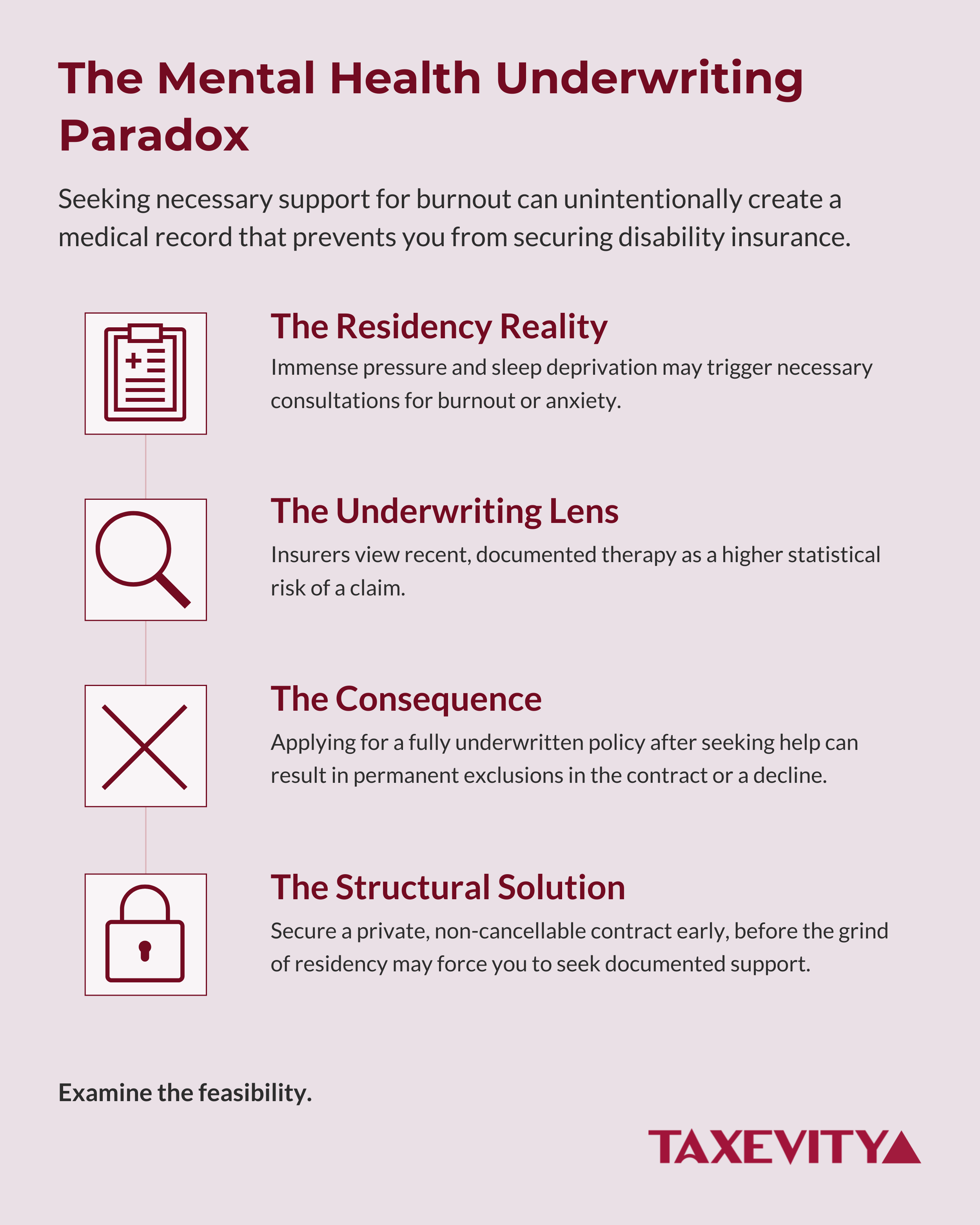
As a result, they may issue your policy with a psychiatric exclusion—meaning they will cover physical injuries, but they will never pay a claim if you are disabled due to a psychological condition. In more severe cases, they may decline your application entirely.
The paradox is cruel: the very training required to become a doctor often creates the medical history that prevents you from securing the insurance you need to protect your career.
3. The Architectural Solution: The Permanent Shield
There is a clean, structural solution to this paradox.
You need to secure your disability insurance architecture now, ideally while your medical record is relatively clear and before the grind of residency forces you to seek documented support.
When you secure a private, non-cancellable disability insurance contract, you lock in your insurability on the day the contract is signed. “Non-cancellable” means the insurer cannot cancel the policy, alter the definitions, or increase your premiums before age 65, regardless of how your health changes.
If you sign the contract today, and six months from now the stress of residency requires you to seek ongoing therapy or take a leave of absence, your financial architecture is completely shielded. The insurer cannot retroactively add a psychiatric exclusion to an existing non-cancellable contract. You are protected, and you are free to get the care you deserve without fear of financial penalty.
4. The Association Plan Illusion
A common trap for busy residents is assuming that the disability insurance offered by their provincial medical association (such as the OMA, Doctors of BC, or Doctors Manitoba) is sufficient protection. It’s easy to sign up for and heavily marketed to you.
While these association plans are accessible, relying on them as the primary foundation of your architecture is a mistake.
Association plans are group contracts. You do not own the policy; the association does. Because of this, the definitions of disability can be altered, and the premiums are usually age-banded, meaning they get progressively more expensive as you get older. Furthermore, if the overall group of physicians makes too many claims, the insurer can raise the rates for everyone.
To build a permanent, reliable foundation, you require a private, individual contract. You need a policy where you are the sole owner, the definitions are strictly tailored to your specific medical specialty (known as “Own Occupation”), and the pricing is contractually locked in for your entire career.
5. Bypassing the Financial and Medical Roadblocks
You might be thinking, “I don’t have the time to go through medical exams, and my resident salary isn’t high enough to justify a massive policy.”
RBC Insurance recognizes this friction and offers simplified programs specifically designed for your career stage (such as the RBC Medical Student Offer).
Through these simplified offers, active residents can typically secure up to $4,500 per month in tax-free benefit coverage without having to undergo physical medical exams, blood tests, or urine collection. Importantly, if you pay your premiums with personal, after-tax dollars, this $4,500 monthly benefit is paid out completely tax-free.
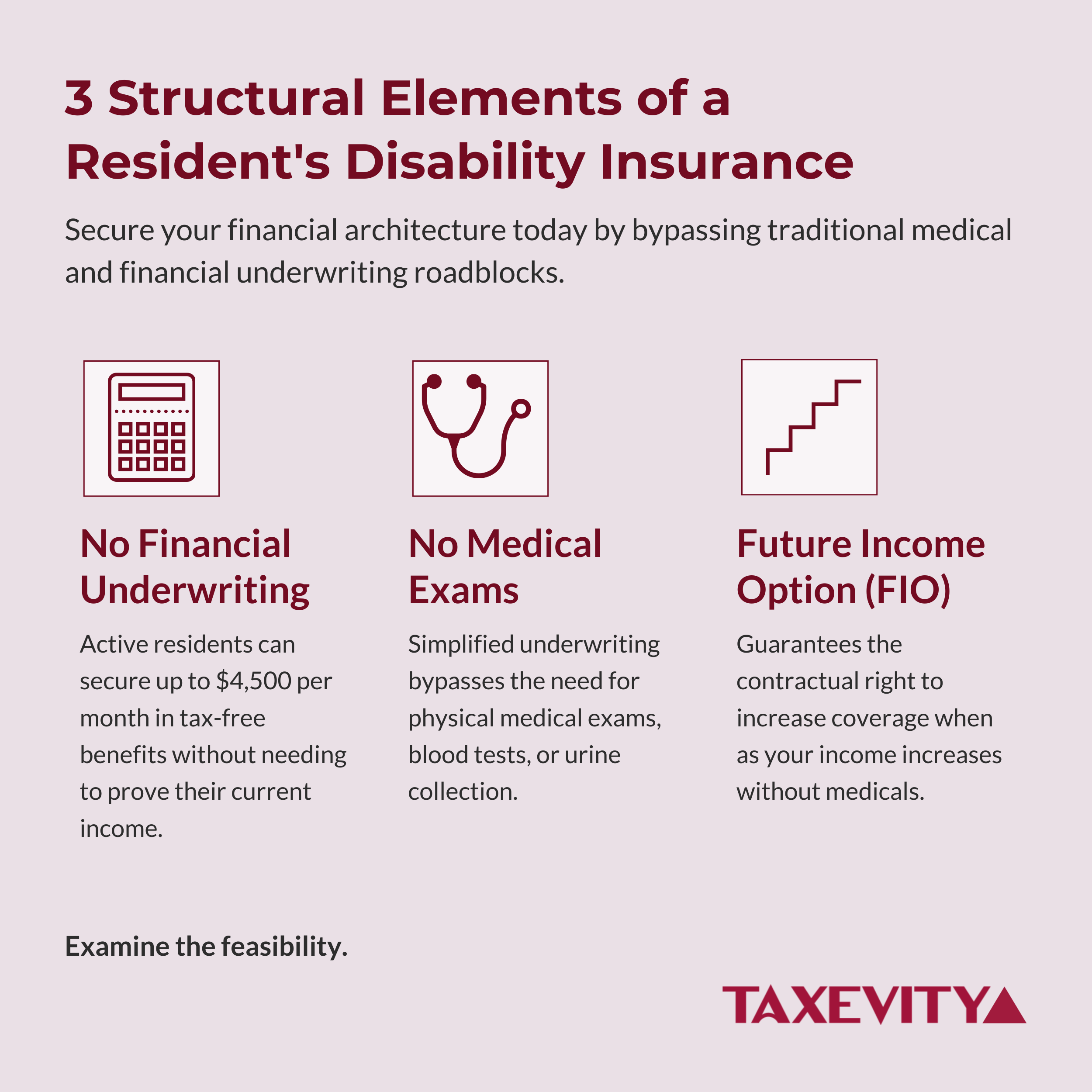
Furthermore, these programs completely bypass traditional financial underwriting. The insurer isn’t looking at your current resident T4 slips to justify the $4,500 limit; they are basing it entirely on your trajectory as a physician.
Most importantly, these foundational policies can include a Future Income Option (FIO). This rider gives you the contractual right to increase your coverage limits dramatically once you become an attending physician, without ever having to answer another medical question. You lock in your resident-level health, but secure the right to protect your attending-level income.
Frequently Asked Questions
Do I have to disclose therapy if I’ve already seen a counselor?
Yes. Insurance applications are legal documents requiring truthful answers from you. If you are asked about consultations for stress, anxiety, or burnout, you must answer honestly. Failure to disclose this can result in a claim being denied later due to misrepresentation.
What happens if I already have a documented mental health history?
You should still apply. Answering affirmatively usually results in a psychiatric exclusion, but your policy may still fully cover you for physical injuries, illnesses, cancers, and accidents. Furthermore, insurers may allow you to apply to have the mental health exclusion removed after a certain number of years if you can demonstrate you have remained entirely symptom-free and treatment-free during that time.
Can I just rely on my hospital or resident union’s group benefits?
No. While resident unions provide valuable group benefits during your training, that coverage ceases the moment you graduate and transition to an attending physician or fellow. You cannot take that group coverage with you, leaving you entirely exposed if you developed a medical condition during residency that makes you uninsurable in the private market.
Verify the feasibility.
Protecting your multi-million dollar human capital shouldn’t punish you for seeking support during residency. Before you rely on a structurally flawed group association plan, ensure your private coverage is permanently shielded.
- Bypass the Paradox: Discuss your specific timeline to secure a guaranteed baseline before the mental health underwriting paradox affects your insurability.
- Review the Architecture: We will build your custom projections live on-screen, comparing simplified issue programs against fully underwritten options for your specialty.
- Lock in the Shield: If you decide the strategy is feasible, we will guide you through the e-application process so you can get back to your rotation.
Schedule a private, 25-minute interactive video meeting to explore your options.
The Series: The Medical Trainee’s Guide to Disability Insurance
This post is part of a five-stage architectural blueprint for protecting your medical career. Review the complete framework:
- Part 1: Deconstructing the RBC Medical Student Offer
- Part 2: The Resident’s Guide to the Mental Health Paradox (This Post)
- Part 3: The Clinical Fellow’s Financial Blueprint
- Part 4: Medical Association vs. Private Disability Insurance: A Structural Comparison
- Part 5: The Future Income Option (FIO): Protecting Unearned Capital

At Taxevity Insurance, we’re passionate about bringing clarity to complex financial decisions. Let us empower you with personalized strategies to achieve your goals. We focus on life and health insurance solutions to protect your business, your family, and your legacy.


