

Key Question for Medical Fellows
How can you protect your future multi-million dollar attending income while navigating the complex financial transition of a fellowship?
- The Vulnerable Transition: As a medical fellow, you are bridging the gap between a trainee’s stipend and a massive attending salary. However, your multi-million dollar human capital is highly vulnerable right now; if your health fails, your compounding student debt remains but the future wealth never materializes.
- Bridging the Gap with FIO: To shield this transition, you must activate the Future Income Option (FIO) on your foundational private disability policy. A Special Option Increase allows you to immediately scale your tax-free coverage up to first-year attending limits without providing new financial proof or answering medical questions.
- Structural Discipline: Before prematurely complicating your architecture by incorporating your practice, ensure your individual foundation is secure. This means securing a strict “Own Occupation” definition to protect locum income and ensuring your private contract provides cross-border portability if you train internationally. Verify the feasibility of this transitional blueprint.
As a medical fellow, you exist in a unique professional and financial position. You are operating at an incredibly high level, possessing the expertise of an attending physician. Financially, however, your revenue still reflects that of a trainee, and the psychological weight of a six-figure student line of credit is a significant factor.
You are approaching a massive income transition. Within the next one to three years, your financial complexity is going to multiply exponentially. You will shift from managing a modest stipend to navigating independent contractor status, corporate tax structures, and attending-level revenue.
The financial industry knows this, which is why your inbox may be flooded with aggressive pitches for wealth management, complex corporate insurance schemes, and incorporation services.
Before you complicate your financial architecture, you need to execute a few highly specific, structural moves to bridge the gap between your training and your attending career.
Think of this as your conversational blueprint for navigating the fellowship transition.
1. The Debt vs. Income Reality
The defining financial characteristic of a fellowship is delayed gratification. You are postponing a massive attending salary for an additional year or two to achieve highly specialized expertise.
Meanwhile, your student line of credit is actively compounding.
The natural instinct for some fellows is to jump into aggressive, complex investment or insurance strategies pitched by advisors promising rapid wealth accumulation. Our advice is the opposite: maintain structural discipline.
Your immediate priority is not rapid wealth accumulation; it is ensuring that the millions of dollars of human capital you are about to unleash in the marketplace is sound. If your health fails during this final transition period and you cannot practice your sub-specialty, the debt remains, but the attending income never materializes.
2. Scaling Your Architecture: Activating the FIO
If you followed the standard architectural path, you likely secured a baseline private disability insurance policy (such as the RBC Medical Student Offer) during medical school or residency, capping out around $4,500 per month. Note that if you pay your premiums with personal, after-tax dollars, the disability benefit you receive is completely tax-free.
As a fellow, you are now permitted to carry up to $8,500 per month in tax-free coverage without having to provide any financial proof of income.
More importantly, you are approaching the most critical insurance milestone of your career: the transition to practice. When you sign your attending contract, your lifestyle and financial obligations will require significantly more protection—often $15,000 to $25,000 per month.
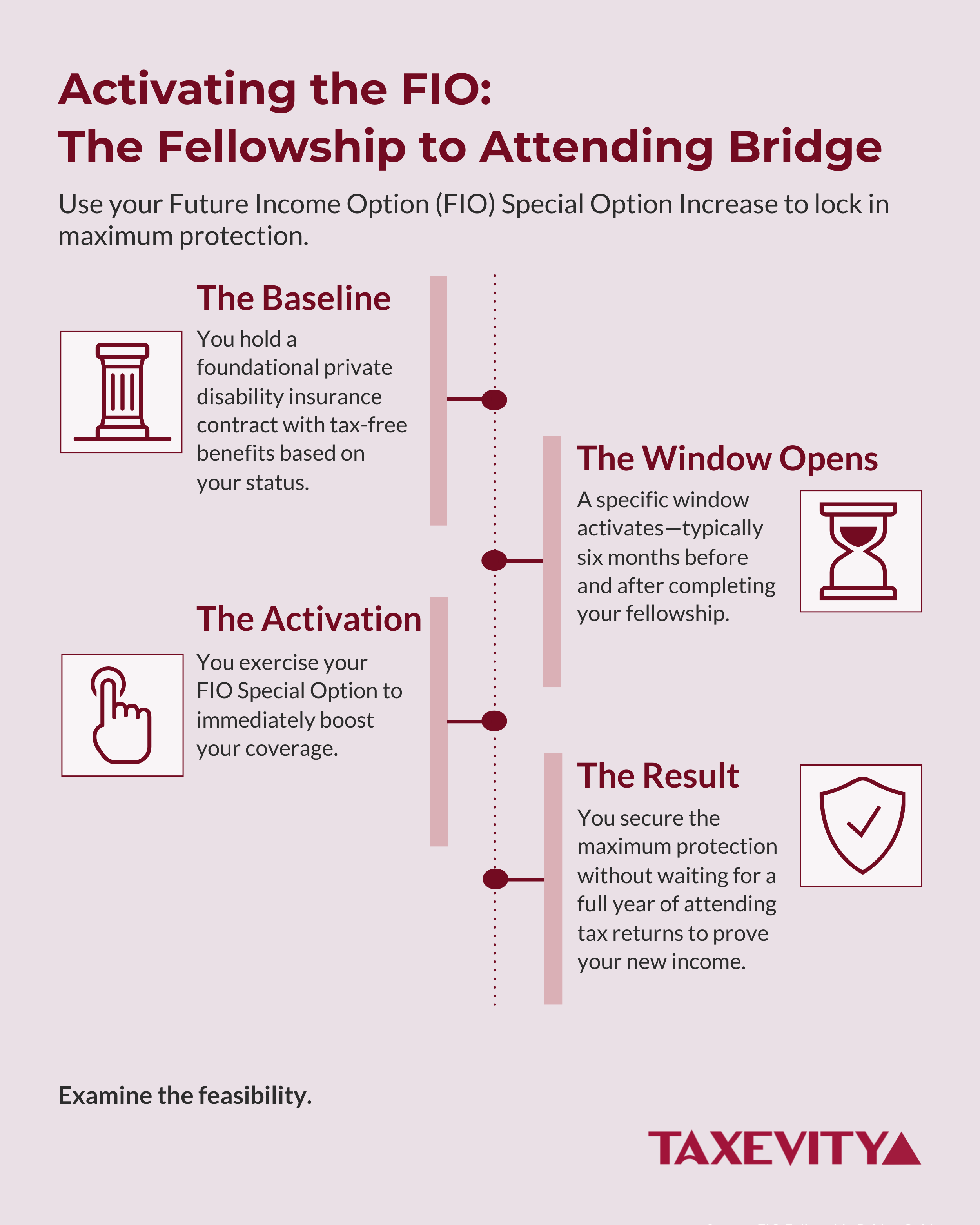
If your baseline policy includes a Future Income Option (FIO) rider, you hold the contractual right to increase your coverage as your income rises, without ever answering another medical question.
The Special Option Increase
RBC Insurance offers a Special Option Increase designed exactly for your current stage. During a specific window—typically opening six months before you complete your fellowship and closing six months after—you can exercise your FIO to immediately jump your coverage to first-year attending limits (often $11,000+ per month).
You do not need to wait for a full year of attending tax returns to prove your new income. You simply use your FIO to bridge the gap, locking in maximum protection before you even walk through the doors on your first day as an attending.
3. The Cross-Border Complication
A significant percentage of Canadian specialists complete their fellowships in the United States or internationally to train at world-renowned institutions. This introduces a severe structural vulnerability if you are relying on the wrong type of insurance.
If your primary disability coverage is through a Canadian provincial medical association (like the OMA or Doctors of BC), you must read the fine print carefully. Because these are group contracts tied to provincial residency and association membership, your coverage may be severely limited, altered, or outright voided if you move out of the country for a year or two.
If you hold a private, individual contract, your coverage may be portable. Whether you are doing a fellowship at the Mayo Clinic, Johns Hopkins, or overseas, a private Canadian contract typically remains legally binding and fully active. If you become disabled while training abroad, your private policy pays your tax-free benefit in Canadian dollars, exactly as promised. It is important to review your specific contract for any geographic restrictions.
4. Locums and the True “Own Occupation”
To supplement their income and aggressively attack their lines of credit, many fellows take on locum tenens shifts.
This is often your first introduction to earning income as an independent contractor rather than an employee. It also highlights exactly why a strict “Own Occupation” definition in your disability contract is non-negotiable.
If you suffer an injury that prevents you from performing the highly specialized procedures of your fellowship training, but you are still physically capable of doing basic general practice locums or administrative consulting, a generic insurance policy might refuse to pay your claim, arguing that you can still work in the medical field.
A true “Own Occupation” definition explicitly protects your highly specialized skillset. It ensures that if you cannot perform the duties of your specific sub-specialty, the insurer will pay your full tax-free benefit—even if you choose to pivot and earn alternative income through consulting, teaching, or non-procedural medicine.
5. The Incorporation Question
As you begin earning locum income and sign your attending contract, you will inevitably be asked: “Have you set up your Medical Professional Corporation (MPC) yet?”
While incorporating provides massive tax-deferral advantages for high-earning physicians, doing it prematurely during fellowship is often a structural misstep. Setting up and maintaining an MPC involves significant legal and accounting fees. If your primary goal during fellowship is using your locum income to pay down personal non-deductible debt (like your student line of credit), incorporating too early simply traps those funds inside a company, forcing you to pay personal tax to extract them anyway.
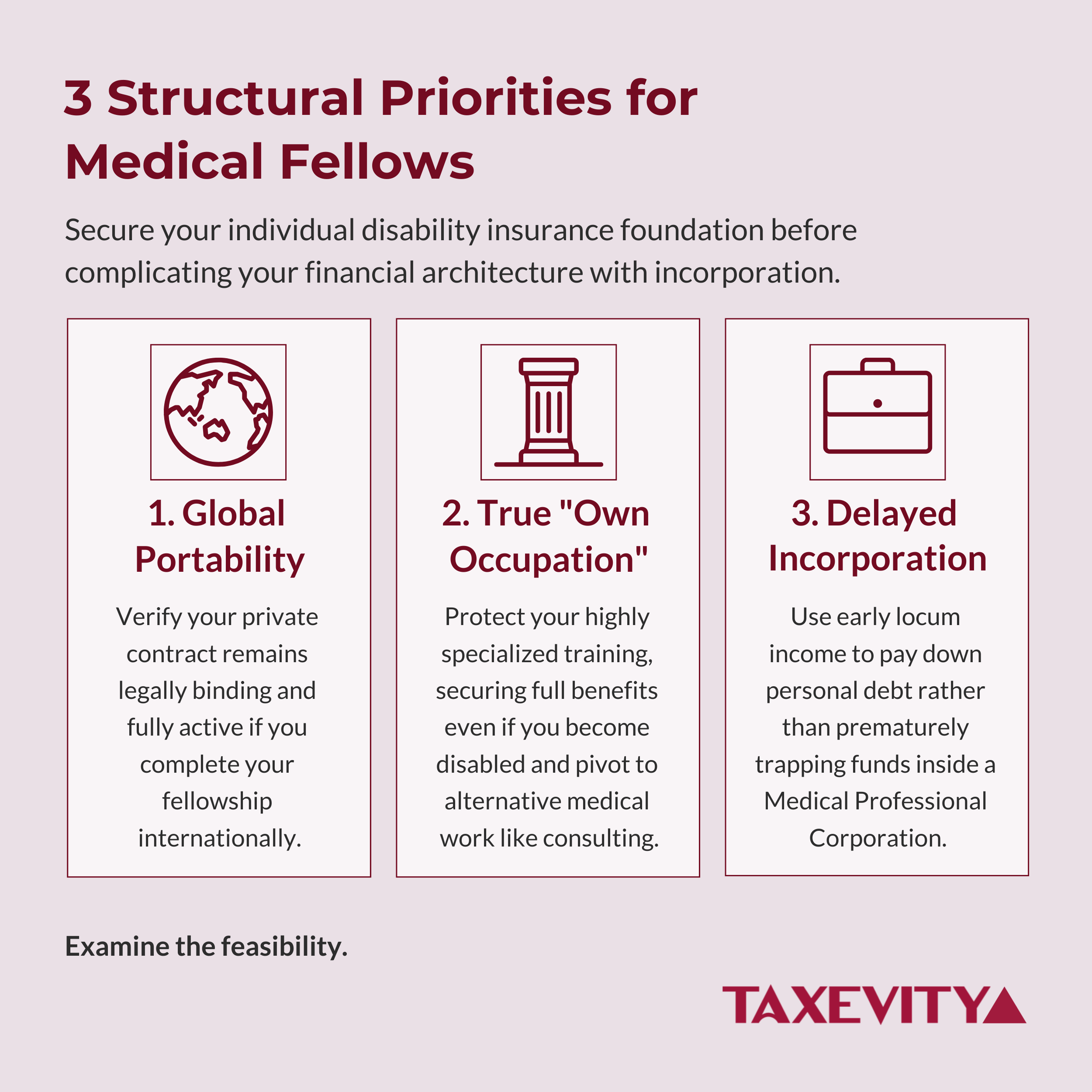
Use this transitional period to map out your debt repayment strategy and secure your individual disability insurance personally. Once your attending revenue stabilizes and you are generating more cash than you need for your personal lifestyle, that’s usually a better time to establish an MPC to shelter that surplus wealth.
Frequently Asked Questions
Does my Canadian disability insurance cover me during a US fellowship?
If you hold a private, individual contract, your coverage may be portable. Private policies are often fully portable worldwide, but you must verify the specific details of your contract. However, if you rely solely on a provincial association group plan, your coverage may be restricted or voided while residing outside of Canada.
Should I use my extra locum income to pay down my line of credit or buy more disability insurance?
Both are critical, but securing your foundational disability insurance should come first. A $150,000 line of credit is manageable on an attending’s salary; a total loss of your multi-million dollar future human capital is catastrophic. Use your locum income to fully fund your private disability policy (and activate your FIO), then aggressively funnel the remainder toward your debt.
Can I deduct my disability insurance premiums on my taxes?
Generally, no. If you pay your disability insurance premiums with personal, after-tax dollars, the monthly benefit you receive if you become disabled is completely tax-free. This is the structurally preferred method. If you attempt to deduct the premiums as a business expense, the CRA will heavily tax any benefits paid out to you during a claim, severely reducing your protective safety net.
Verify the feasibility.
The transition from medical fellow to attending physician introduces immense financial complexity. Before you complicate your architecture with corporate structures , ensure your foundational shield is fully scaled to protect your impending revenue.
- Activate Your FIO: Discuss your specific timeline for scaling your coverage up to attending levels using the Special Option Increase, completely bypassing financial and medical underwriting.
- Review Your Contract: We will review your architecture live on-screen to ensure your current policy has the cross-border portability required for international fellowships and true “Own Occupation” definitions to protect independent locum income.
- Map the Transition: If you decide the strategy is feasible, we will guide you in locking in your individual foundation now.
Schedule a private, 25-minute interactive video meeting to explore your options. The agenda is yours.
The Series: The Medical Trainee’s Guide to Disability Insurance
This post is part of a five-stage architectural blueprint for protecting your medical career. Review the complete framework:
- Part 1: Deconstructing the RBC Medical Student Offer
- Part 2: The Resident’s Guide to the Mental Health Paradox
- Part 3: The Clinical Fellow’s Financial Blueprint (This Post)
- Part 4: Medical Association vs. Private Disability Insurance: A Structural Comparison
- Part 5: The Future Income Option (FIO): Protecting Unearned Capital

At Taxevity Insurance, we’re passionate about bringing clarity to complex financial decisions. Let us empower you with personalized strategies to achieve your goals. We focus on life and health insurance solutions to protect your business, your family, and your legacy.


