

Key Question for Canadians
How do you look beyond simplistic comparisons to select a Canadian life insurer to secure your legacy?
- The Risk Reality: Relying solely on the highest projected yield or the lowest premium is a flawed strategy. Even in the highly regulated Canadian market , past insolvencies—like Confederation Life in the 1990s—resulted in years of stress, frozen cash values, and delayed claims. When you are relying on a policy for liquidity or estate taxes, a delay is a failure.
- The Objective Framework: You can evaluate the dozens of life insurers operating in Canada across three structural dimensions: solvency and governance, scale and market capacity, and corporate structure. Analyzing metrics like the LICAT ratio and the size of the participating account reveals an insurer’s ability to perform under severe economic stress and smooth out market volatility.
- Architected Certainty: Understanding these structural differences allows you to match the institution to your specific strategic goals. This helps determine if you prioritize the absolute alignment of a mutual insurer or the emergency capital-raising leverage of a publicly traded stock insurer. Before you commit capital, make sure you verify the feasibility.
The Canadian life insurance marketplace is highly regulated and incredibly stable. Because of strict OSFI (Office of the Superintendent of Financial Institutions) solvency requirements, Canada Revenue Agency (CRA) tax-exempt rules, and fundamental actuarial principles, product designs naturally converge. Independent advisors have access to the same major insurers, meaning uncompetitive products rarely survive in the high-net-worth market.
Because premiums, performance projections, and policy contracts are remarkably similar across the top tier, focusing purely on chasing the highest projected yield or the lowest premium is a flawed, simplistic strategy.
For HNW individuals, incorporated professionals, and business owners, the foundational purpose of life insurance is to transfer risk and provide guaranteed liquidity—ultimately securing certainty and control for heirs. Beyond this core protection, permanent cash value life insurance can also facilitate tax-advantaged growth and expand your capacity for long-term philanthropic or legacy impact. Therefore, the prudent strategy is to focus on the structural strength of the institution backing the promise, and how the solution itself is engineered.
The HNW Risk Reality: Why Insurer Selection Matters
A common industry myth is that “no Canadian policyowner has ever lost a dollar,” often citing the insolvency of Confederation Life in the 1990s. While it is true that the industry and regulators stepped in to protect policy values, the reality of that insolvency—which involved what was then one of Canada’s largest mutual insurers—resulted in years of stress, frozen cash values, and delayed claims. For a HNW client relying on a corporate policy for liquidity or estate taxes, a delay is a failure.
Furthermore, while the industry protection fund (Assuris) guarantees 100% of death benefits and cash values for smaller policies, coverage is capped at 90% for larger policies (death benefit above $1,111,111 or cash value above $111,111). On a $10,000,000 corporate policy, a 10% reduction represents a staggering $1,000,000 loss of capital. For HNW families, relying on Assuris is not an option; we must select an insurer who’s built to last.
You can distill the dozens of life insurers operating in Canada into a manageable number by evaluating them across three structural dimensions.
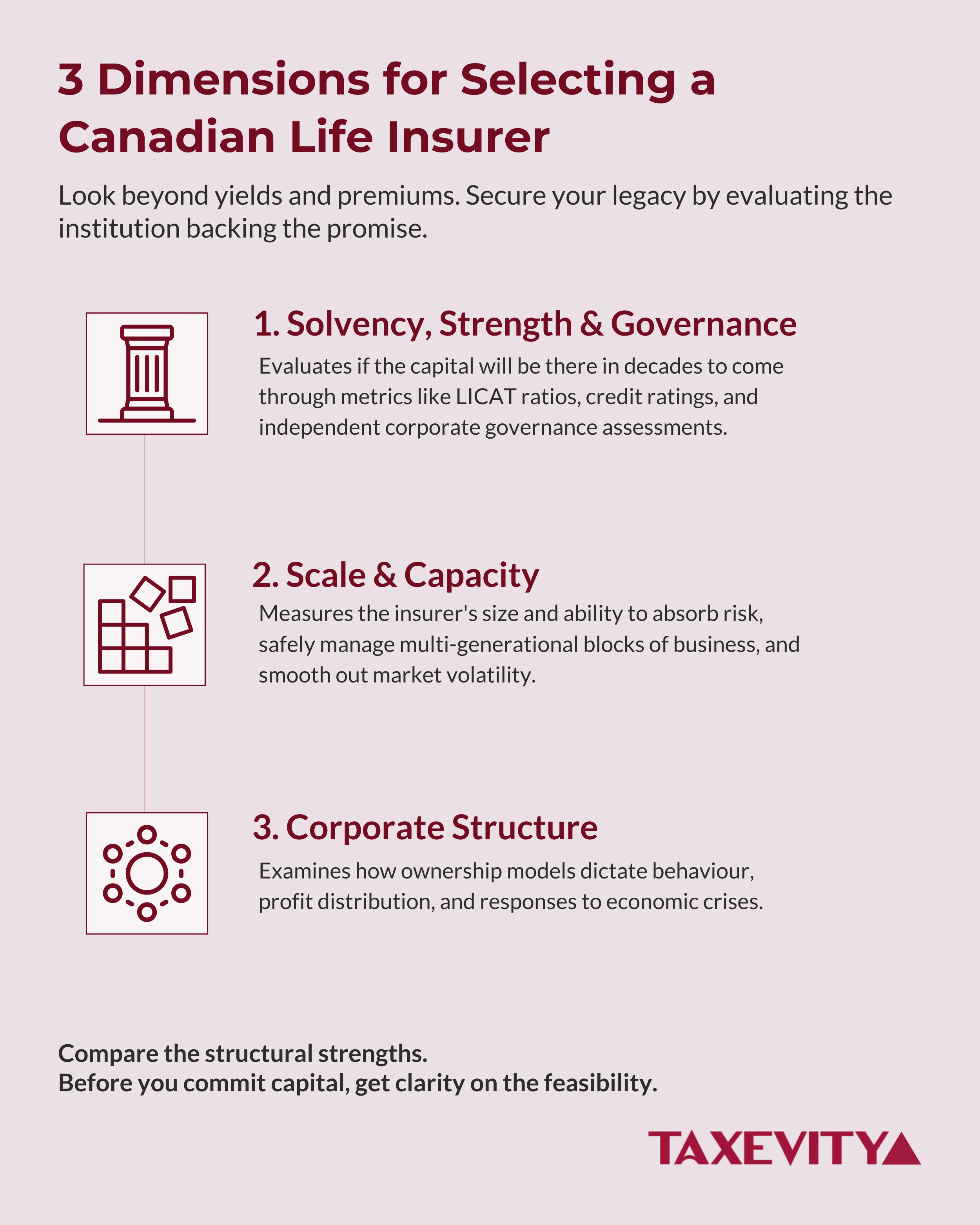
Dimension 1: Solvency, Strength & Governance
Will the capital be there in decades to come? Is the leadership team making prudent, transparent promises?
| Evaluation Metric | What It Measures | Relevance to Corporate Clients |
| LICAT Ratio | The Life Insurance Capital Adequacy Test (LICAT) measures the capital buffer an insurer holds above what is required to meet obligations during severe economic stress. | Demonstrates performance under adversity. A high ratio means a strong foundation for your corporate asset transfer strategy. |
| Regulator & Corporate Domicile | Whether the insurer’s solvency and corporate operations are regulated federally by OSFI or provincially (e.g., the Autorité des marchés financiers, or AMF, in Quebec). | While your specific policy is governed by your home province’s Insurance Act, the insurer’s regulator determines how strictly their capital reserves are audited in a crisis. |
| Corporate Governance | Independent assessments evaluating board independence, diversity, and risk oversight. | Good governance is a leading indicator of an insurer’s commitment to keeping its long-term promises and avoiding reckless risk-taking. |
| Credit Ratings | Objective, third-party assessments (AM Best, Standard & Poor’s / S&P, Moody’s, Fitch) of financial health. | Provides external validation of the institution’s ability to seamlessly pay out massive multi-million dollar claims. |
Dimension 2: Scale & Market Capacity (Load-Bearing Mass)
Does the insurer have the sheer size to absorb risk and smooth out market volatility? Can they safely manage multi-generational blocks of business?
| Evaluation Metric | What It Measures | Relevance to You |
| Total Assets Under Management & Parental Backing | The total financial resources controlled by the insurer or its parent financial group. | Indicates market footprint and staying power. For bank-owned insurers, we evaluate the consolidated assets of the parent bank too, as credit rating agencies factor in the reputational risk that virtually guarantees the bank would support their insurance subsidiary. |
| Size of Participating (Par) Account | The separate asset pool backing par whole life policy benefits and dividends. | A larger, mature par pool provides the inertia needed for superior return smoothing and dividend stability—the engine of tax-advantaged wealth accumulation. |
Dimension 3: Corporate Structure (Capital vs. Alignment Levers)
Different ownership models dictate how an insurer behaves, distributes profits, and responds to economic crises. Understanding these categories helps you match the foundational corporate structure to your specific strategic goals.
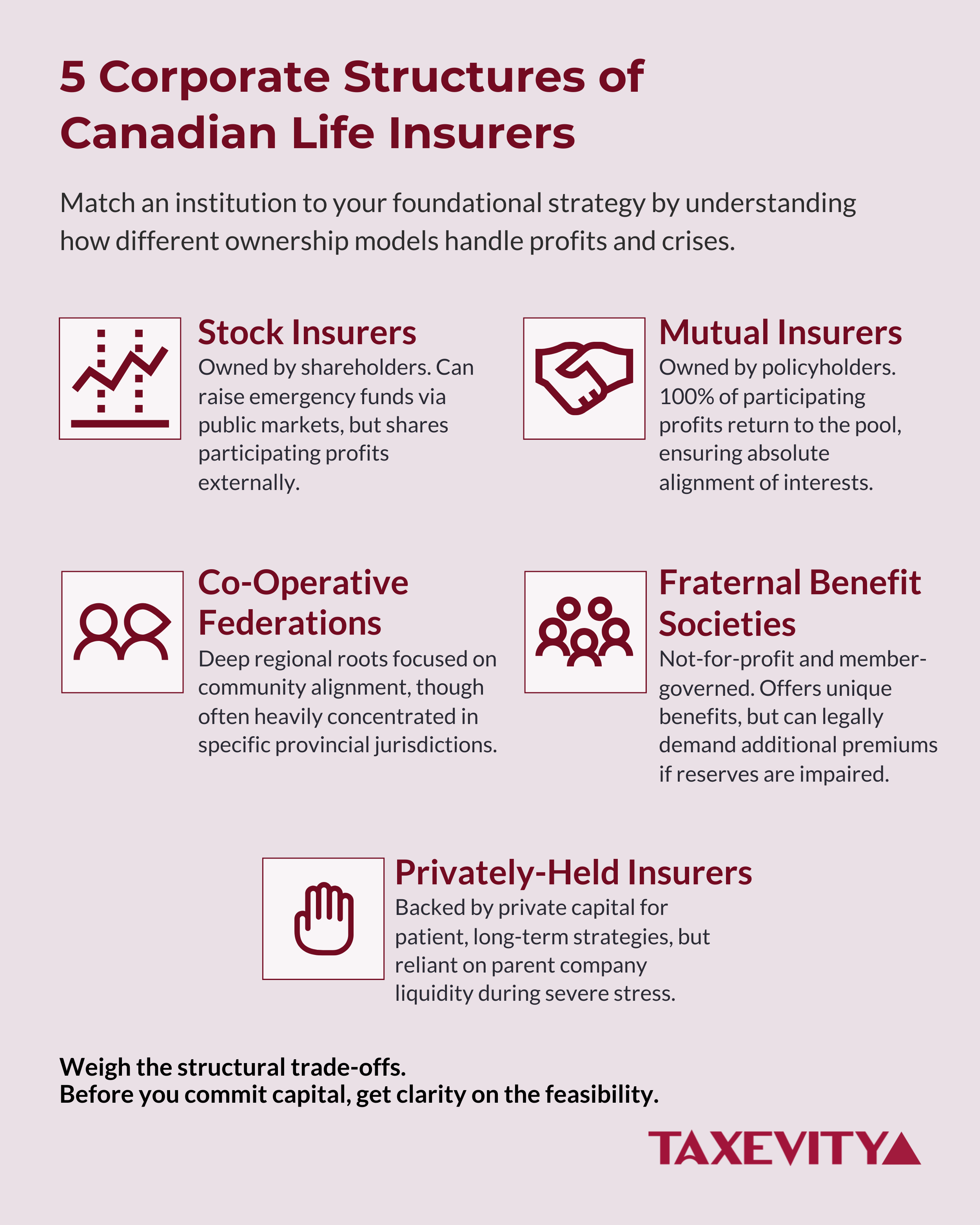
1. Publicly Traded (Stock) Insurers
Examples: Sun Life, Manulife, Canada Life (via Great-West Lifeco)
Owned by public shareholders, these massive conglomerates balance shareholder returns with policyholder dividends.
- The Advantage (The Capital Lever): In a severe global financial crisis, they can issue new shares to public markets to quickly raise massive amounts of systemic emergency capital.
- The Trade-Off: They must share a small portion (typically 2.5%) of participating account profits with external public shareholders, which reduces the growth policyholders achieve.
2. Mutual Insurers
Examples: Equitable Life
Owned entirely by participating policyholders, with absolutely no external shareholders.
- The Advantage (The Alignment Lever): Absolute alignment of interests. 100% of participating account profits are distributed directly back to the participating pool.
- The Trade-Off: They cannot issue public stock to raise emergency capital; they are reliant on their retained surplus during acute market stress.
3. Co-operative Federations
Examples: Desjardins, Beneva
Institutions operating on a cooperative model (a federation of member caisses or credit unions).
- The Advantage (The Community Lever): They possess deep regional roots with a strong focus on community and member alignment.
- The Trade-Off: Their unique governance structure and heavy concentration in specific provincial jurisdictions require a different analytical lens compared to traditional stock or mutual insurers.
4. Fraternal Benefit Societies
Examples: Knights of Columbus, Foresters Financial
Organizations that exist solely to benefit members who share a common bond (often religious, professional, or community-based).
- The Advantage (The Affinity Lever): Specialized organizations that offer unique member benefits and operate with a focus on the well-being of their specific community.
- The Trade-Off: They are not-for-profit, member-governed. They can legally demand additional premiums from their members or proportionately reduce benefits if capital reserves become impaired. Their unique regulatory and social structure makes them difficult to compare directly to traditional stock or mutual insurers.
5. Privately-Held Insurers
Examples: Empire Life
Insurance companies owned primarily by a private holding company or a wealthy family.
- The Advantage (The Patient Capital Lever): Backed by private ownership, they can take a long-term, patient view on investments and strategy without the quarterly earnings pressure of public markets.
- The Trade-Off: They cannot issue public stock to raise capital, making them reliant on their own retained surplus (accumulated profits) and the liquidity of their private parent company during market stress.
The Next Step: The Side-by-Side Comparison
Recognizing that an institution’s structural strength matters far more than a projected sales illustration is the first step. To make a truly informed decision, you must evaluate your options through a standardized, objective framework. When we show comparisons side-by-side, we often see our clients’ priorities shift as the underlying trade-offs become clear.
Before you commit capital, get clarity on the feasibility.
Selecting the right life insurer is about more than comparing premiums; a stress-tested strategy ensures the institution backing your policy has the structural integrity to deliver when it matters most.
- Just starting? Review the 4 Feasibility Gates to see if you qualify.
- Evaluating a proposal? Stress-test the structure with an independent Feasibility Audit.
- Looking for feasible designs? Explore our Structural Design Process.

At Taxevity Insurance, we’re passionate about bringing clarity to complex financial decisions. Let us empower you with personalized strategies to achieve your goals. We focus on life and health insurance solutions to protect your business, your family, and your legacy.


